Download
1 / 17
180 likes | 315 Vues
Born on July 24, 1843, in Albano, near Rome, Eugene de Blaas was an influential Austrian painter known for his captivating Venetian genre scenes. Coming from a talented artistic family, he was trained by his father, renowned portrait painter Karl de Blaas. Established in Venice, Eugene became a leading figure, responding to the late 19th-century demand for art that captured the vibrant life by the canals. His works celebrated the human experience, featuring local fishermen, gondoliers, and the beauty of Venetian settings.

E N D
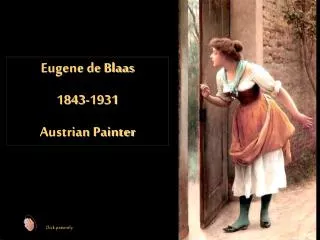
Eugene de Blaas 1843-1931 Austrian Painter Click patiently
Eugene de BlaasAustrian, 1843-1931Eugene de Blaas was born July 24, 1843 at Albano, near Rome, to Austrian parents. His career was enriched by a talented and artistic family. His father, Karl (1815-1894), was one of the most notable portrait painters of Roman society, a successful history, portrait and fresco painter of the late Biedermeier period. He became teacher to Eugene and his brother Julius (b.1845), an artist in his own right who specialized in animal and military scenes. Karl eventually took a position as a professor at the Academies in Vienna and Venice, then part of the Austro-Hungarian Empire. It was in Venice that Eugene de Blaas established himself as the leading painter of Venetian genre. Venice had been an essential stop on the Grand Tour since the early eighteenth century. Past visitors had returned home with views and portraits and the late-nineteenth century visitor wanted more. The affluent Venetian visitor wanted human interest, a sense of life by the canals and neighborhoods of the city, and as a result, a school of artists developed to supply this market. Native Italian artists like Antonio Paolettu, Antonio Rotta and de Blaas, as well as Englishmen such as Luke Fildes and William Logsdail depicted the lives of Venetian fisher folk, gondoliers and Venetian beauties.