Download
1 / 37
390 likes | 600 Vues
Explore a unique perspective on cancer causation focused solely on water, alongside a deep dive into the expanding universe. This text discusses the implications of the Cosmological Principle—how matter is distributed and the universe's fate—as revealed through Edwin Hubble’s observations, including redshift and the Hubble Constant. Delve into the Big Bang's origins, the role of dark matter, and the future of cosmic expansion. While the theory surrounding water and cancer may provoke debate, the scientific principles governing our universe are based on evidence and observation.

E N D
An Expanding Universe Astronomy 112 Chapter 18 & 21
But… let’s talk ‘science’ • I have a theory… • Water causes cancer • Only water causes cancer • Not cigarettes… • Not UV radiation… • Not nothing else… • Who/how it affects cannot be predicted • Now or ever
But… let’s talk ‘science’ • I have a theory… • Water causes cancer • Only water causes cancer • Who/how it affects cannot be predicted • Evidence: • Every single cancer victim has been exposed to water • Rebutting evidence to the contrary: • Not every lung cancer victim smokes • Not every smoker gets lung cancer
Cosmology • Study of the universe, including • Structure – how matter is arranged • History – how stars, galaxies, and structure change • Origins – conditions at early times • Fate – ultimate future of the universe
Cosmological Principle • We assume two properties of the universe • Homogeneous – generally same in all places • Isotropic – same in all directions
Cosmological Principle • We assume two properties of the universe • Homogeneous – generally same in all places • Isotropic – same in all directions
Cosmological Principle • We assume two properties of the universe • Homogeneous – generally same in all places • Isotropic – same in all directions
Cosmological Principle • We assume two properties of the universe • Homogeneous – generally same in all places • Isotropic – same in all directions
Cosmological Principle • We assume two properties of the universe • Homogeneous – generally same in all places • Isotropic – same in all directions
Cosmological Principle • We assume two properties of the universe • Homogeneous – generally same in all places • Isotropic – same in all directions • These assumptions are confirmed by observations. • But are true on large scales
Edwin Hubble • Redshift
Edwin Hubble • Redshift
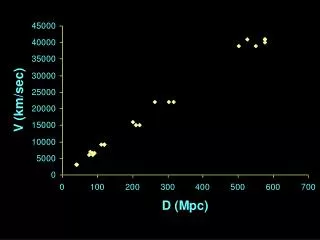
Edwin Hubble • Hubble’s Law
Edwin Hubble • Hubble’s Law
Edwin Hubble • Hubble’s Law
Edwin Hubble • Hubble’s Law • …so it appears that everything in the universe emerged from a dense (hot) initial state and exploded outward… • Or everything was perfectly placed to provide that impression
Hubble Constant H0 • Hubble constant is a fundamental number • It tells us the age of the universe • To measure/determine: • We need to have distances to galaxies • We need to have things inside galaxies with known luminosity • Type I SN are especially good • Determine SN luminosities with distance ladder
Hubble Constant H0 • Distance Ladder
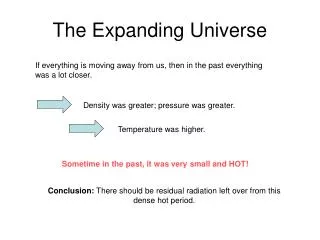
Hubble Constant H0 • Ideas • Space is doing the expanding • Distant galaxies have a large look-back time • Hubble maps space into time • Galaxies will be farther apart in the future • Galaxies were closer together in the past • If expansion has been going on for long time, galaxies were once very close together • Hubble time is the time when separation was zero
Redshift and Scale Factor • Redshift tells us how much the universe has expanded since a galaxy’s light was emitted • Scale factor RU • z=1 gives RU = 0.5… the universe was half it’s current size when light was emitted from galaxy
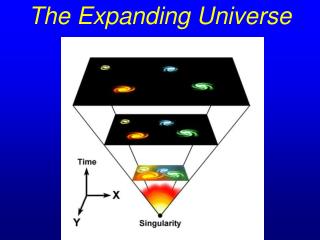
The Big Bang • H0 ≈ 70.8±4.0 (km/s)/MPc • Hubble time was 13.8 billion years ago • This moment is called the Big Bang • The Big Bang happened everywhere • Does not affect atoms, stars, or anything else • Everything in universe was once in very small (!) volume
The Big Bang • Small volume • Conditions hot, above a few thousand K • As expansion proceeds, temperature (pressure) drops • Hydrogen goes from hot/ionized to cool/neutral • Called recombination • Recombination emits light
The Big Bang • Cosmic Microwave Background (CMB) • also Cosmic Background Radiation (CBR) • Light from recombination • Planck spectrum – blackbody radiation • Emitted long ago • Comes from far away • Highly redshifted
The Big Bang • Cosmic Microwave Background (CMB)
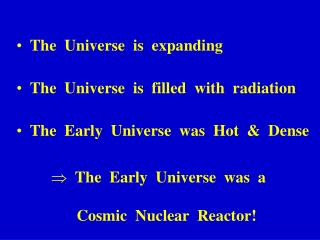
The Big Bang • Predictions • Before recombination, much hotter & denser • At high densities, nuclear reactions occur • Big Bang nucleosynthesis (primordial nucleosynthesis) • Predicts 24% of matter is helium • Observed! • Dark matter cannot be protons or neutrons
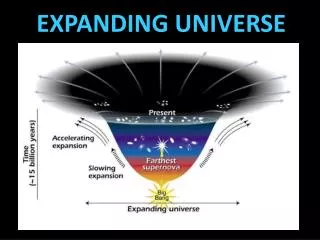
The future… • Universe is expanding now • Future expansion might be faster or slower • Expansion could halt and reverse • Answer depends upon how much matter is in the universe • Ordinary matter (gravity) slows expansion • It is not known if there is enough to halt expansion
The Cosmological Constant • Will expansion halt? • If Ωmass = 1, density is at critical mass density • If Ωmass > 1, expansion will stop and the universe will contract • If Ωmass < 1, expansion will continue forever • Ordinary stars & galaxies Ω = 0.02 • Dark matter within/between galaxies Ω = 0.3
The Cosmological Constant • Will expansion halt?
The Cosmological Constant • But expansion is speeding up!
The Cosmological Constant • But expansion is speeding up!
The Cosmological Constant • But expansion is speeding up! • There is energy (described by the cosmological constant) that is pushing space outward • Called ΩΛ • We measure ΩΛ from • Supernovae • galaxy clusters • ΩΛ ≈ 0.7
The Cosmological Constant • But expansion is speeding up! • There is energy (described by the cosmological constant) that is pushing space outward • Called ΩΛ • We measure ΩΛ from • Supernovae • galaxy clusters • ΩΛ ≈ 0.7
Challenges • Big Bang doesn’t explain everything • Flatness problem – the Ωmass + ΩΛ is very close to 1 • Horizon problem – the CMB is exactly the same in all directions • Inflation • Rapid expansion of universe at extremely early times • Solves flatness and horizon problems Applause