Download
1 / 14
150 likes | 350 Vues
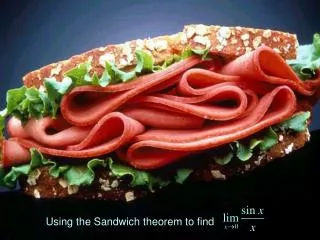
This text explores the application of the Sandwich theorem to determine limits in mathematical functions. It demonstrates how graphing can show discrepancies between left-hand and right-hand limits, indicating that neither limit exists. Through a creative proof, it illustrates the importance of the Sandwich theorem in resolving these issues. The discussion also includes references to unit circles and inequalities, emphasizing the steps needed to effectively apply this theorem. Understanding these concepts is crucial for tackling complex limit problems in calculus.

E N D
Unfortunately, neither of these new limits are defined, since the left and right hand limits do not match. Unfortunately, neither of these new limits are defined, since the left and right hand limits do not match. If we graph , it appears that We might try to prove this using the sandwich theorem as follows: We will have to be more creative. Just see if you can follow this proof. Don’t worry that you wouldn’t have thought of it.
P(x,y) 1 (1,0) Unit Circle
T P(x,y) 1 O A (1,0) Unit Circle
T P(x,y) 1 O A (1,0) Unit Circle
T P(x,y) 1 O A (1,0) Unit Circle
T P(x,y) 1 O A (1,0) Unit Circle
T P(x,y) 1 O A (1,0) Unit Circle
T P(x,y) 1 O A (1,0) Unit Circle
T P(x,y) 1 O A (1,0) Unit Circle
T P(x,y) 1 O A (1,0) Unit Circle
multiply by two divide by Take the reciprocals, which reverses the inequalities. Switch ends.