Investigating Heavy Quarkonia Production in Hot Dense Medium at RHIC
170 likes | 297 Vues
This study delves into the production of heavy quarkonia in the context of Quantum Chromodynamics (QCD). The mass of heavy quarks serves as an essential external parameter affected by the initial gluon density and distribution, leading to distinct energy loss features compared to light quarks. Through measurements from RHIC's PHENIX and STAR collaborations, we explore the suppression patterns and flow characteristics of heavy quarkonium, revealing critical insights into the hot, dense medium formed during heavy-ion collisions, including the cold nuclear matter effects and primary contributions to energy loss.


Investigating Heavy Quarkonia Production in Hot Dense Medium at RHIC
E N D
Presentation Transcript
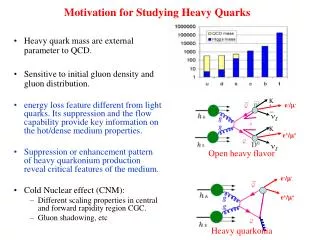
K+ e-/- l K- e+/+ D0 l Open heavy flavor e-/- e+/+ Heavy quarkonia Motivation for Studying Heavy Quarks • Heavy quark mass are external parameter to QCD. • Sensitive to initial gluon density and gluon distribution. • energy loss feature different from light quarks. Its suppression and the flow capability provide key information on the hot/dense medium properties. • Suppression or enhancement pattern of heavy quarkonium production reveal critical features of the medium. • Cold Nuclear effect (CNM): • Different scaling properties in central and forward rapidity region CGC. • Gluon shadowing, etc
PHENIX How the Measurements is done at RHIC
0-80% Au+Au STAR STAR Preliminary How the Measurement is done at RHIC
u u u light K+ c l l l D0 K+ Hot/Dense Medium c quark e-/- c D0 D0 meson energy loss Ivan, et al Heavy Quark Energy Loss in the Medium K+ Hot/Dense Medium “dead cone effect”: gluon radiation suppressed at q< mQ/EQ c quark e-/- c D0 radiative energy loss (D. kharzeev, M.Djordjevicet al. ) Hot/Dense Medium c quark e-/- collision energy loss (Teany, Ralf, Denes et al.)
5 N-N collisions The larger the energy loss The smaller the RAA Variables to quantify the medium effect RAA ( or RdA) “no effect” No medium effect • Heavy quarks are from Hard collision: • Each collision is separated clearly. • In the absence of any nuclear effect, • Yield(A+A) = yield(p+p)*N(collisions), i.e. scale with number of collisions (Ncoll)
l K+ • STAR Measurement • different measurements • lots of material to produce background. p K- p D0 Open heavy flavor How Measurements has been done K+ e-/- • PHENIX Measurement • Little material to produce background. • different methods K- e+/+ D0 l Open heavy flavor
STAR hadrons pT> 6 GeV/c Measurements on RAA in Au+Au collisions • large suppression of charm quark production is observed • D meson probably less suppressed than light hadrons. • Where the bottom show up in the spectrum?
Do we Understand the Result? PHENIX nucl-ex/0611018 STAR nucl-ex/0607012 • Radiative Energy Loss with reasonable gluon densities do not explain the observed suppression • Djordjevic, Phys. Lett. B632 81 (2006) • Armesto, Phys. Lett. B637 362 (2006) • Collisional EL may be significant for heavy quarks • Wicks, nucl-th/0512076 • van Hess, Phys. Rev. C73 034913 (2006) • heavy quarks fragment inside the medium and are suppressed by dissociation? • Adil and Vitev, hep-ph/0611109 • Similar suppression for B and D at high-pT
z y x Energy Loss and Flow are Closely connected Charm was NOT expected to flow with the medium since it’s too heavy !
Flow of electrons from Charm and Bottom meson decay [Phys.Lett. B595 202-208 ] [PRC72,024906] [PRC73,034913] [PRB637,362] • Strong elliptic flow for non-photonic electron • Main source is D meson -> indicate non-zero D v2 • Charm v2 also non-zero ? • Bottom sneak in here?
c c d Quarkonia Suppression: “smoking gun” for QGP Physics Letter B Vol.178, no.4 1986 • Low temperature • Vacuum J/y • High temperature • High density • (screening effect take place) d D- D+ The melting sequence: cc -> Y’ -> J/y -> Upsilon
c c c The life of J/y in the medium is very complicated • Observed J/y is a mixture of direct production+feeddown. • All J/y ~ 0.6J/y(Direct) + ~0.3 cc + ~0.1y’ • Important to disentangle different component (through upgrade) • Suppression and enhancement in the “cold” nuclear medium • Nuclear Absorption, Gluon shadowing, initial state energy loss, Cronin effect and gluon saturation (CGC) • Hot/dense medium effect • J/y dissociation, i.e. suppression • Recombination from uncorrelated charm pairs • Survival (or not) in the hot/dense medium from lattice calculation J/y D+
Measurements J/y (in medium) in the world • FNAL: • E772/789/866: p+A • Sqrt(s) = 38.8 GeV • HERA-B: • p+A • Sqrt(s) ~42 GeV • SPS: • NA3, NA38/50/60: p+p, p+A, A+A • Sqrt(s) = 18, 20, 28, 30 GeV • RHIC: • PHENIX/STAR: p+p, p+A, A+A • Sqrt(s) =20, 62, 130, 200 GeV
NA50 at SPS (0<y<1) PHENIX at RHIC (|y|<0.35) PHENIX at RHIC (1.2<|y|<2.2) NA50 at SPS (0<y<1) PHENIX at RHIC (|y|<0.35) PHENIX at RHIC (1.2<|y|<2.2) NA50 at SPS (0<y<1) PHENIX at RHIC (|y|<0.35) NA50 at SPS (0<y<1) NA50 (0<y<1) NA50 (0<y<1) NA50 (0<y<1) Bar: uncorrelated error Bracket : correlated error Global error = 12% and Global error = 7% are not shown Bar: uncorrelated error Bracket : correlated error Global error = 12% is not shown Normalized by NA51 p+p data with correction based on Eur. Phys. J. C39 (2005) : 355 Comparing RHIC to SPS Suppression results One of the key observations for CERN to declare QGP discovery. • After removing the CNM effect, differences start to show-up. • suppression at SPS consistent with the melting of psi’ and chi_c. • Suppression pattern similar in RHIC and SPS. • CNM effect not removed yet.
J/ Yan,Zhuang,Xu nucl-th/0608010 Golden Comparisons • Charm flows. If recombination is correct, J/Psi should also flow. • PHENIX expect to accomplish in run7 with higher luminosity (x3) and better (~sqrt(3.5)) reaction plane resolution. Single electron from open charm meson • Charm suppression increase at higher pT. If recombination is correct, J/Psi suppression should quadratically increased at higher pT. • Not yet observed in PHENIX up to 5GeV. • What the minimum pT to see the pattern? Single electron from open charm meson
Purdue High Energy Physics P3MD lab Heavy Flavor Silicon Tracker Upgrade: the core of RHIC-II heavy flavor program