Download
1 / 1
10 likes | 147 Vues
This work investigates potential research avenues for Geospatial Cyberinfrastructure (GCI) focusing on social heterogeneity to identify relevant geospatial issues. It emphasizes the transformation from data to actionable information and explores the use of Semantic Web technologies for enhancing knowledge creation. The aim is to develop geospatial middleware for effective service delivery and evolution among stakeholders, promote citizen science, and advance GCI within the realm of geospatial cloud computing. A comprehensive research agenda is proposed to foster collaboration and address the needs of diverse communities.

E N D
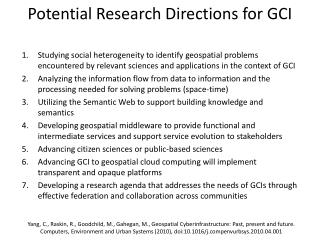
Potential Research Directions for GCI Studying social heterogeneity to identify geospatial problems encountered by relevant sciences and applications in the context of GCI Analyzing the information flow from data to information and the processing needed for solving problems (space-time) Utilizing the Semantic Web to support building knowledge and semantics Developing geospatial middleware to provide functional and intermediate services and support service evolution to stakeholders Advancing citizen sciences or public-based sciences Advancing GCI to geospatial cloud computing will implement transparent and opaque platforms Developing a research agenda that addresses the needs of GCIs through effective federation and collaboration across communities Yang, C., Raskin, R., Goodchild, M., Gahegan, M., Geospatial Cyberinfrastructure: Past, present and future. Computers, Environment and Urban Systems (2010), doi:10.1016/j.compenvurbsys.2010.04.001