Download
1 / 8
80 likes | 216 Vues
Washington Heights faces a critical issue with youth loitering after school due to a lack of engaging programs. This analysis identifies the absence of diverse arts and chess programs as contributing factors, while highlighting the limitations of existing community-based offerings, which mainly focus on academics and athletics. To develop effective solutions, we propose creating workshops, pilot programs, and fostering partnerships with organizations to enrich after-school options. Addressing these needs will not only curb loitering but also empower youth through engaging and educational activities.

E N D
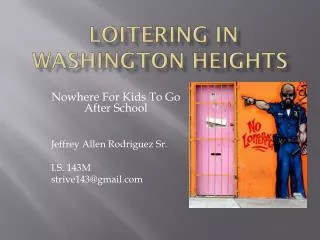
Loitering in Washington Heights Nowhere For Kids To Go After School Jeffrey Allen Rodriguez Sr. I.S. 143M strive143@gmail.com
6 Steps of the Public Policy Analyst (PPA) • Define the problem • Gather the evidence • Identify the causes • Evaluate and existing policy • Develop solutions • Select the best solution (Feasibility vs. Effectiveness) http://www2.maxwell.syr.edu/plegal/TIPS/welcome.html
The Problem Loitering in Washington Heights • Lack of afterschool Arts programs • Lack of afterschool Chess programs
The Evidence • CBO’s predominantly focus on academics and athletics (although these are worthy programs, they are limited) • The nearest Chess In The Schools programs are in lower Manhattan or The Bronx • Some schools offer wonderful afterschool music programs but they are limited to their students only • Funding for the arts continues to diminish community and citywide
The Causes • Limited variety of afterschool programs • Lack of information • Lack of resources • Cultural indifference
Existing Policy • Supplemental Education Services (SES) offer small group academic assistance • SES programs offer 1 on 1 academic assistance • Dept. of Educ. 37.5 minutes afterschool classes offer small group academic assistance • Community Based Organizations (CBO’s) offer small group academic assistance • CBO’s offer basketball programs
Develop Solutions • Provide workshops for the community • Pilot programs in early grade ie. Pre K/Kindergarten (Elementary schools) Grade 6 (Middle School) Grade 9 (High School) • Research grant options for resources • Partnership/Collaborate with CBO’s to diversify afterschool programs
Select Best Solution • Which solution(s) is most feasible? Which is most effective?