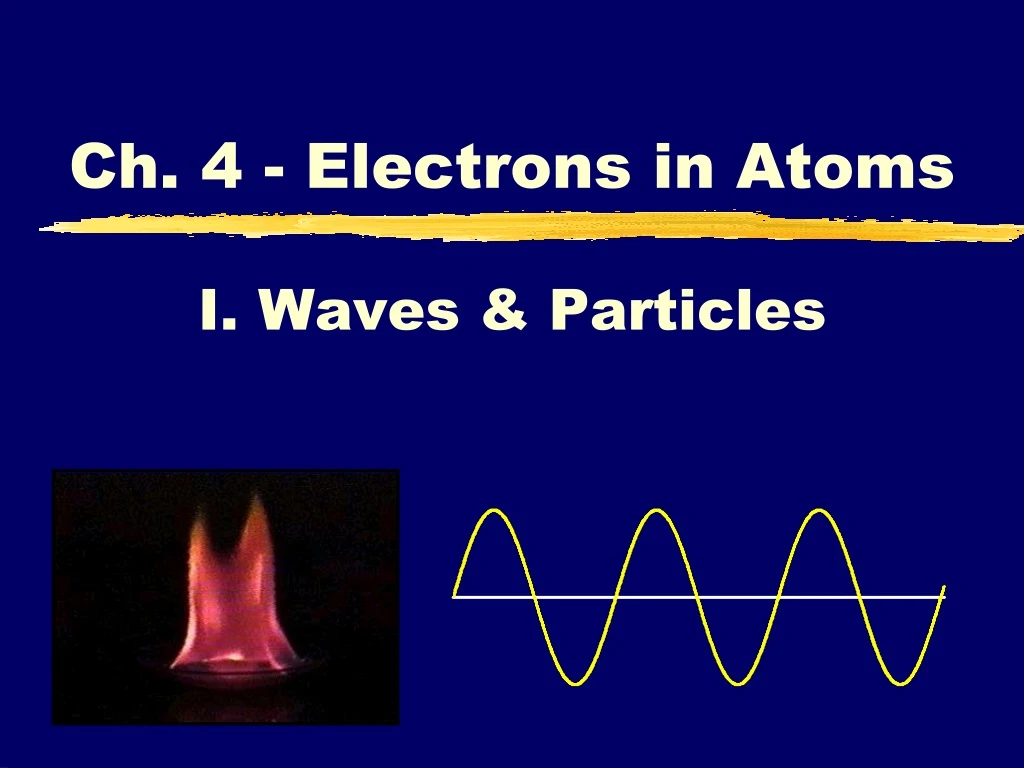

Light and Electrons: Waves and Particles
E N D
Presentation Transcript
Ch. 4 - Electrons in Atoms I. Waves & Particles
Light and Electrons • Because light and electrons have common properties, understanding one helps to understand the other.
Electromagnetic radiation • Energy that exhibits wave-like behavior as it travels • Includes: gamma rays, X-rays, infrared, visible spectrum, microwaves, ultraviolet rays, radio and TV waves
EM Spectrum HIGH ENERGY LOW ENERGY
R O Y G. B I V red orange yellow green blue indigo violet EM Spectrum HIGH ENERGY LOW ENERGY
Waves • Wavelength () - length of one complete wave (measured in m, cm, nm) • Frequency () - # of waves that pass a point during a certain time period • hertz (Hz) = 1/s (s-1) • Amplitude (A) - distance from the origin to the trough or crest
crest A A origin trough Waves greater amplitude (intensity) greater frequency (color)
EM Spectrum • Frequency & wavelength are inversely proportional c = c: speed of light (3.00 108 m/s) : wavelength (m, nm, etc.) : frequency (Hz)
WORK: = c = 3.00 108 m/s 7.50 1012 Hz EM Spectrum • EX: Calculate the wavelength of radiation whose frequency is 7.50 x !012 Hz. GIVEN: • = 7.50 x !012 Hz = ? c = 3.00 108 m/s = 4.00 10-5 m
Light as Particles • A property which could not be explained in terms of waves was a phenomenon known as the photoelectric effect – refers to the emission of electrons from a metal when heated or lit.
Quantum Theory • Planck (1900) • Observed - emission of light from hot objects • Concluded - energy is emitted in small, specific amounts (quanta) • Quantum - minimum amount of energy change
Classical Theory Quantum Theory Quantum Theory • Planck (1900) vs.
Quantum Theory • The energy of a photon is proportional to its frequency. E: energy (J, joules) h: Planck’s constant (6.6262 10-34 J·s) : frequency (Hz) E = h
Quantum Theory • EX: Find the energy of a photon with a frequency of 3.55 1017 Hz. GIVEN: E = ? = 3.55 1017 Hz h =6.6262 10-34 J·s WORK: E = h E = (6.6262 10-34 J·s) (3.55 1017 Hz) E = 2.35 10-16 J
Quantum Theory • Einstein (1905) • Observed - photoelectric effect
Quantum Theory • Einstein (1905) • Concluded - light has properties of both waves and particles “wave-particle duality” • Photon - particle of light, having zero mass, carrying a quantum of energy
Quantum Theory • Radiation is emitted and absorbed only in whole numbers of photons
Ch. 4 - Electrons in Atoms II. Bohr Model of the Atom
A. Line-Emission Spectrum excited state ENERGY IN PHOTON OUT ground state
B. Bohr Model • Linked the atom’s electron with photon emission • e- exist only in paths, or orbits, with specific amounts of energy called energy levels • Therefore… • e- can only gain or lose certain amounts of energy • only certain photons are produced
Energy of photon depends on the difference in energy levels e- jumps up when energy is absorbed-gives off light when is falls back down B. Bohr Model 6 5 4 3 2 1
C. Other Elements • Each element has a unique bright-line emission spectrum. • “Atomic Fingerprint” Helium • Bohr’s calculations only worked for hydrogen!
A. Electrons as Waves • Louis de Broglie (1924) • Applied wave-particle theory to e- • e- exhibit wave properties
B. Quantum Mechanics • Heisenberg Uncertainty Principle • Impossible to know both the velocity and position of an electron at the same time
B. Quantum Mechanics • SchrödingerWave Equation (1926) • treated e- moving around the nucleus as waves • defines probability of finding an e- • defines mathematically the wave properties of electrons
Radial Distribution Curve Orbital B. Quantum Mechanics • Orbital (“electron cloud”) • Region in space where there is 90% probability of finding an e-