Recent Electroweak Results from Tevatron: Insights from CDF and DØ Collaborations
280 likes | 401 Vues
Junjie Zhu from the State University of New York at Stony Brook presents the latest electroweak results from the Tevatron in this 2008 Aspen seminar, highlighting significant findings from the CDF and DØ collaborations. The talk covers single W and Z boson production, inclusive cross-sections, and differential measurements of particle properties, including the Z boson rapidity and transverse momentum. Results show consistency with Standard Model predictions, further constraining parton distribution functions and providing critical insights for future experiments at the LHC.


Recent Electroweak Results from Tevatron: Insights from CDF and DØ Collaborations
E N D
Presentation Transcript
Recent Electroweak Results from Tevatron Junjie Zhu State University of New York @ Stony Brook For the CDF and DØ Collaborations ASPEN 2008 January 15, 2008
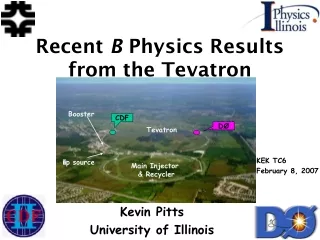
Tevatron, CDF and DØ • Vector boson factory: • Rate/week (L ~ 30 pb-1) • ~700,000 W • ~150,000 Z • ~400 WW, ~120 WZ, ~50 ZZ, … • All physics results: • CDF: http://www-cdf.fnal.gov/physics/physics.html • DØ: http://www-d0.fnal.gov/Run2Physics/WWW/results.htm Junjie Zhu
Electroweak Results 2007 • Single W and Z boson production: • Z inclusive cross section (DØ, 1 fb-1) • Z boson rapidity (d/dy) (CDF 1.1 fb-1, DØ 0.4 fb-1) • Z boson pT (d/dpT) (DØ 1 fb-1) • W charge asymmetry (CDF 1 fb-1, DØ 0.3 fb-1) • W mass (CDF 0.2 fb-1) • W width (CDF 0.35 fb-1) • Diboson production: • Wg (CDF 1 fb-1, DØ 1 fb-1) • Zg(DØ, 1 fb-1) • WZ (CDF 1.9 fb-1, DØ 1 fb-1) • ZZ (CDF 1.5 fb-1, DØ 1 fb-1) • WW/WZ ljj (CDF 1.2 fb-1) Junjie Zhu
Single W and Z boson production • Properties of the W and Z bosons • Measure inclusive and differential cross sections • Tests of SM calculations • Constrain parton distribution functions (PDFs) Junjie Zhu
Z inclusive cross section • DØ (1 fb-1): Z()(hadron) • 1527 candidates with 20% backgrounds • (ppZ)x Br (Z) = 247 ± 8(stat.) ± 13(syst.) ± 15(lumi.) pb • Consistent with SM prediction 251.9+5-11.8 pb • Experimentally important for all studies such as H search - Junjie Zhu
Z boson rapidity (d/dy) • Provides a stringent test of QCD • Both CDF andDØ results agree well with the NNLO predictions (Anastasiou et.al. PRD 69, 094008 (2004)) • More data needed in order to be sensitive to PDFs Z boson rapidity and the parton momenta: 2/dof=30/30 2/dof=20/27 PRD 76, 012003 (2007) Junjie Zhu
Z boson transverse momentum (d/dpT) • pT(Z)=0 @ LO • pT(Z)0 @ NLO • Increased qg and gg contributions can broaden Z boson pT spectrum • Process involving small-Bjorken-x parton(s), resummation form factor needs to be modified “small-x broadening effect” • This effect only shows up for Zs with |y|>2 (0.002<x<0.006) • Expected to be more pronounced at LHC Emission of single high pT parton Dominated at high pT (pT>50 GeV) Perturbative QCD calculation Emission of multiple soft gluons Dominated at low pT (pT<30 GeV) Gluon resummation calculation Berge et.al. PRD 72, 033015 (2005) Junjie Zhu
Z boson pT spectrum for low pT region All y • Gluon resummation calculations work well for Zs in all rapidity regions • First measurement of Z boson pT spectrum for |y|>2 at Tevatron • First test of “small-x broadening effect” using high rapidity Zs • Our data prefers the traditional calculation without small-x effect included ResBos from Balazs/Yuan (PRD 56, 5558 (1997)) 2/dof=11/11 2/dof=32/11 2/dof=9/11 Submitted to PRL arXiv: 0712.0803 Junjie Zhu
Z boson pT spectrum for high pT region NLO • Normalized differential cross section (1/d/dpT) for pT<260 GeV • Highest center-of-mass energy measurement of Z pT over the largest phase space available to date • Overall uncertainties greatly improved compared withDØRun I measurement • Disagreement of the data and NNLO calculations for pT > 30 GeV • The NNLO calculation agrees in shape with the data NNLO NNLO calculation from Melnikov/Petriello (PRD 74, 114017 (2006)) Submitted to PRL arXiv: 0712.0803 Junjie Zhu
dσ/dy (nb) √s = 1.96 TeV Rapidity y W charge asymmetry - - • u + d W+u + d W- • u quarks typically carry more of a proton’s momentum than d quarks • Use W’s to probe the proton structure • A(y) sensitive to u(x)/d(x) • W l A(y) difficult to measure • Lepton charge asymmetry: convolution of W asymmetry and V-A interaction from W decay Junjie Zhu
Accepted by PRD arXiv 0709.4254 Lepton and W charge asymmetry • CDF, W e: W charge asymmetry • Reconstruct yW distribution using W mass constraint • Weight the two solutions by taking W boson production and decay into account • DØ, W : muon charge asymmetry • Experimental uncertainties are already smaller than orcomparablewith the CTEQ uncertainties in some regions Junjie Zhu
W Mass and Width MW = 81 GeV MW = 80 GeV • CDF: W e and W using MT spectrum • Simulate MT(e/ ) distribution with a fast parameterized MC • MC simulates QCD and QED corrections • Utilize real data to calibrate the detector response to lepton and recoil system, parameterize the responses in fast MC • Fit MT templates (with W mass and width varying) to the data • Good understanding of the lepton and recoil system is the key: • Muon momentum scale and resolution (J/,, Z resonances) • Electron energy scale and resolution (E/p in We and Zee resonance) • Recoil system response (Zee and Z) MW: sensitive to the edge of MT W: sensitive to the tail of MT Junjie Zhu
W Mass PRL 99, 151801 (2007) MW = 80413±48 MeV (0.06%) Single most precise measurement to date! Junjie Zhu
W Width Accepted by PRL arXiv; 0710.4112 • CDF, 350 pb-1, e +μchannel: Most precise single direct measurement! W = 2032 73 (stat + syst) MeV Junjie Zhu
Summary for Mw and Γw • World average uncertainty for Mw reduced by 15%: 29 25 MeV • World average uncertainty forΓw reduced by 22%: 60 47 MeV • The Tevatron has now the best measurement of Γw • May soon surpass the combined precision of the LEP2 experiments on Mw • By the end of Run II, Mw from Tevatron is expected be known better than 25 MeV Junjie Zhu
Effects on SM Higgs mass • Constraint on SM Higgs mass: (< 144 GeV at 95% C.L.) • Expect a light SM Higgs Junjie Zhu
Diboson production • Measure cross sections • Probe gauge boson self-interactions • consequence of non-Abelian nature of SU(2)LU(1)Y • Sensitive to new physics in TGC (trilinear gauge couplings) • Tevatron complementary to LEP • Explores higher center-of-mass energy than LEP • Different combinations of couplings • Backgrounds to Higgs, top, SUSY Junjie Zhu
Wg production • Sensitive to WWg coupling • Variation in Wg production would be sign of new physics • Particularly high Pt photons TGC • DØ preliminary MT(lg) > 90 GeV μchannel: (W μg) = 3.21 ± 0.52 pb e channel: (W eg) = 3.12 ± 0.42 pb theory: (W lg) = 3.21 ± 0.08 pb • CDF preliminary 30 < MT(l) < 120 GeV: e +μ channel: (W lg) = 18.03 ± 2.83 pb theory: (W lg) = 19.3 ± 1.4 pb Junjie Zhu
Wg: Radiation Amplitude Zero • Radiation amplitude zero: caused by the interference among the tree-level diagrams at cos(*) = 1/3 • * is the angle between the W and the direction of the incoming quark • Measure charge-sign photon-lepton rapidity difference Q [() - (l)], not * • Test of the SM gauge structure: anomalous WWg couplings can fill in the dip • The probability of the dip is found to be in the range of 80% - 90% • First indication of RAZ in W events at DØ Anomalous coupling SM 2/dof=16/12 Junjie Zhu
ISR DY PLB 653, 378 (2007) FSR Z production • 968 candidates with 116 ±13 backgrounds • Cross section for Z ll with photon ET>7GeV, R(l)>0.9, M(ll) >30 GeV Measured: ( Zg lg ) = 4.96 ± 0.42 pb Theory: ( Zg lg ) = 4.74 ± 0.22 pb Junjie Zhu
Limits on anomalous ZZ and Z couplings • Various SM extentions predict large values of the trilinear couplings of ZZ and Z • Use photon ET spectrum to set limits on anomalous ZZ and Z couplings 2D 95% C.L. limit PLB 653, 378 (2007) • These new limits represent a significant improvement over previous results • The limits on h40(V) are the most stringent to date 1D 95% C.L. limit Other coupling set to SM value Junjie Zhu
TGC Evidence for WZ • Unique sensitivity to WWZ coupling • Final state with 3 e/ and met • DØ observed 13 candidates with 4.5 bkgs • 3 significance • Measured cross section: Accepted by PRD arXiv; 0709.2917 NLO: = 3.7 0.1 pb Junjie Zhu
First observation of WZ process with a 6 significance using 1.1 fb-1 data (PRL 98, 161801 (2007)) Updated this analysis using 1.9 fb-1 data: Observation of WZ Junjie Zhu
Limits on Anomalous WWZ couplings • WZ production probes the WWZ coupling directly • Z boson pT sensitive to TGC CDF =1.5 TeV =2.0 TeV DØ =1.5 TeV =2.0 TeV -0.14<Z<0.16 -0.13<Z<0.14 -0.18<Z<0.22 -0.17<Z<0.21 -0.17<g1Z<0.27 -0.15<g1Z<0.24 -0.15<g1Z<0.35 -0.14<g1Z<0.34 -0.86<Z<1.36 -0.82<Z<1.27 -0.14<Z =g1Z<0.31 -0.12<Z =g1Z<0.29 best limits to date on WWZ TGC’s Junjie Zhu
Search for WW/WZljj • WW/WZ seen only in leptonic channels so far • Topologically similar to WH • Bkgs: W/Z+jets, QCD, etc • S/B < 1% initially • Use a NN to increase significance by ~30% in the signal region • Parameterize dijet mass shapes (signal shape fixed with MC, background shape contains free parameters) • Do an unbinned likelihood fit on data • Statistical significance of 2 • Measured cross section: • WW/WZx Br(Wl, W/Zjj) = 1.47 ± 0.77(stat.) ± 0.38(syst.) pb • Theory: WW/WZx Br(Wl, W/Zjj) = 2.1 ± 0.2 pb • 95% CL Upper limit: x Br < 2.88 pb Junjie Zhu
First evidence for ZZ • No self coupling of Z bosons in SM • Produced in t channel • ZZ 4 charged leptons • CDF (1.5 fb-1) observed 1 event with 0.03 0.02 backgrounds • 2.2 significance • DØ (1 fb-1) observed 1 event with 0.13 0.03 backgrounds • (ZZ/Z*) < 4.4 pb • Set limits on ZZZ and ZZ* couplings • The first bounds on these anomalous couplings from Tevatron • Limits on f40(Z), f50(Z) and f50() are more restrictive than LEP results SM: = 1.6 0.1 pb Submitted to PRL arXiv: 0712.0599 Junjie Zhu
Adding the ll+nn Channel • CDF also looked at ZZ 2 charged leptons+2 neutrinos • Larger production cross sections • Higher WW, DY bkgs • Signal Extraction: • Use matrix element method to define event probability • Use event probability to define likelihood ratio (LR): • Fit to extract signal • 1.9 significance • Combination with 4 lepton channel • Use binned-likelihood • 3.0 combined significance Junjie Zhu
W charge asymmetry Experimental errors close to or better than CTEQ PDF errors New method developed W Cross section Indication of radiation amplitude zero Z Cross section Limits on ZZ and Z couplings W mass and width Best single measurement Mass improved by 15% Width improved by 22% WW/WZ Indication of WW/WZ ljj Z cross section Consistent with SM Important for H WZ First observation Limits on WWZ couplings Z boson rapidity Consistent with NNLO More data needed to be sensitive to PDF ZZ First evidence Limits on ZZZ and ZZ* couplings Z boson pT Gluon resummation calculation works well for all rapidity regions Data higher than NNLO predictions for high pT region Constraint on SM Higgs Electroweak Results 2007 Junjie Zhu