Understanding Redox Reactions: Types, Agents, and Balancing in Acidic Solutions
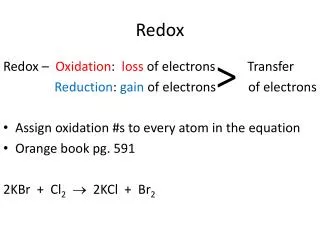
This overview of redox reactions details the oxidation and reduction processes where the oxidation states of at least two elements change. It introduces three primary types of redox reactions—single replacement, synthesis, and certain decomposition reactions. To predict the products, one must identify oxidizing and reducing agents in the reactants. Pay special attention to reactions in acidic or basic solutions, as these are typically redox. Relevant balancing techniques, including the addition of H⁺ and H₂O, are also discussed, illustrated through an example involving tin(II) chloride and potassium permanganate.

Understanding Redox Reactions: Types, Agents, and Balancing in Acidic Solutions
E N D
Presentation Transcript
Redox Net Ionics Oxidation number on at least two elements must change.
Types of Redox RXNS • RXNs: • Single replacement, synthesis, and some decomposition. • To predict products look at the reactants to see if there are oxidizing and reducing agents. • When a problem mention acidic or basic solution, most likely a redoxrxn • When balancing, remember to add H+ and HOH
Example • A solution of tin II chloride is added to an acidic solution of potassium permanganate. • 5Sn⁺² + 16H⁺ +2MnO₄⁻ Mn⁺² + 5Sn⁺⁴ + 8HOH