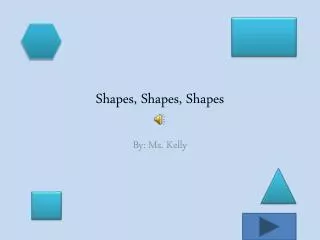
Determining The Relations Between Shapes
This lesson delves into the relationships between four important geometric shapes: hexagon, rhombus, trapezoid, and triangle. We'll discuss their properties, including sides, angles, and types. The hexagon has six sides and is both equilateral and equiangular. The rhombus features four equal sides with opposite sides parallel. The trapezoid has one pair of parallel sides, while the triangle has three sides, also equilateral and equiangular. Practical exercises will help reinforce these concepts, including determining how many shapes fit into one another.


Determining The Relations Between Shapes
E N D
Presentation Transcript
HEXAGON • Six sides • It is a regular polygon • Equilateral (all sides are of equal length) • Equiangular (all interior angles are of equal measure)
RHOMBUS • Four sides • Equilateral (all sides are of equal length) • Opposite sides are parallel
TRAPEZOID • Four sides • One pair of opposite sides are parallel • Isosceles (two sides that are not parallel are of equal length)
TRIANGLE • Three sides • It is a regular polygon • Equilateral (all sides are of equal length) • Equiangular (all interior angles are of equal measure)
Now let’s look at the relations between all four of these shapes…
HEXAGON and RHOMBUS 1 3 1 2 1 hexagon = 3 rhombus
HEXAGON and TRAPEZOID 1 1 2 1 hexagon = 2 trapezoids
HEXAGON and TRIANGLE 1 2 3 1 6 5 4 1 hexagon = 6 triangles
RHOMBUS and TRAPEZOID 1/2 1 1 1 1/2 rhomus = 1 trapezoid
RHOMBUS and TRIANGLE 1 2 1 1 rhombus = 2 triangles
TRAPEZOID and TRIANGLE 1 1 2 3 1 trapezoid = 3 triangles
How many are in ? 1 1/2
If you finish early, you may go to the fun online activity that will give you some more practice with these shapes.http://arcytech.org/java/patterns/patterns_j.shtml