Understanding the Calvin Cycle: Carbon Fixation, Reduction, and Regeneration in Photosynthesis
270 likes | 389 Vues
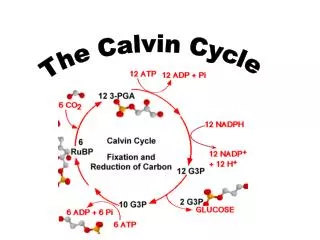
The Calvin Cycle is a crucial part of photosynthesis where carbon dioxide (CO2) is fixed and converted into sugars. This cycle occurs in three main phases: Carbon Fixation, where CO2 is attached to RuBP by RUBISCO; Reduction, where ATP and NADPH convert 3-phosphoglycerate into G3P; and Regeneration, where G3P is rearranged back into RuBP using additional ATP. C3, C4, and CAM plants utilize different mechanisms for carbon fixation, impacting their efficiency, especially in varying environmental conditions. Understanding these processes is key to appreciating plant biology.


Understanding the Calvin Cycle: Carbon Fixation, Reduction, and Regeneration in Photosynthesis
E N D
Presentation Transcript
Ch 10 Notes (part 3): The Calvin Cycle
• Carbon enters the cycle in the form of CO2 and leaves in the form of sugar (C6H12O6) • ATP and NADPH are consumed
• the carbohydrate produced is actually a 3-C sugar: G3P same sugar from Cell. Resp. • to make 1 molecule of G3P, the cycle occurs 3X (consumes 3CO2)
The Calvin Cycle can be divided into 3 phases • Carbon Fixation • Reduction • Regeneration of CO2 acceptor (RuBP)
Phase 1:Carbon Fixation • each CO2 is attached to a 5-C sugar, RuBP, by the enzyme RUBISCO • This forms an unstable 6-C sugar which immediately splits into two 3-C molecules of 3-phosphoglycerate (GP or PGA) 3-C (GP) + 3-C (GP)
Phase 2: Reduction • each GP receives an additional Pi from ATP, forming 1,3-bisphosphoglycerate • Next, a pair of electrons from NADPH reduces the 1,3-bisphosphoglycerate to G3P end product of Calvin Cycle!
18 C atoms 18 C atoms P 3CO2 + 6 G3P 1 G3P (a sugar 3 5-C RuBP to be incorporated into glucose, etc.) 5 G3P (returned to cycle) P P P P P
unstable intermediate GP NADPH CO2 NADP+ RuBP G3P -1 to glucose -5 recycled
Phase 3:Regeneration of RuBP • the 5 molecules of G3P are rearranged through a series of reactions to regenerate RuBP (this uses an additional 3 ATP) • This is the reason for Cyclic electron flow!! Calvin cycle consumes: • 9 ATP • 6 NADPH Leads to negative feedback!
unstable intermediate NADPH more ATP than NADPH is used per molecule of CO2 3 CO2 NADP+ RuBP G3P -1 to glucose -5 recycled
Net Equation for Photosynthesis : chloroplast 6CO2 + 6H2O + light C6H12O6 + 6O2 energy
Mechanisms of C-Fixation • C3 Plants: plants which combine CO2 to RuBP, so that the first organic product of the cycle is the 3-C molecule 3-phosphoglycerate • examples: rice, wheat, soybeans • produce less food when their stomata close on hot, dry days; this deprives the Calvin cycle of CO2 and photosynthesis slows down ~what we've been talking about~
PHOTORESPIRATION:consumes O2, releases CO2 into peroxisomes, generates no ATP, decreases photosynthetic output Product leaves chloroplast O2 replaces CO2 in a non-productive, wasteful reaction; Oxygen OUTCOMPETES CO2 for the enzyme’s active site!
Alternative Mechanisms for C-Fixation
1. C4 Plants:use an alternate mode of C-fixation which forms a 4-C compound as its first product *Calvin Cycle still occurs! This 1st product is an intermediate step prior to Calvin Cycle.
examples: sugarcane, corn, grasses • the 4-C product is produced in mesophyll cells • It is then exported to bundle sheath cells (where the Calvin cycle occurs); Has a higher affinity for CO2 than RuBP does 2 different cells!
once here, the 4-C product releases CO2 which then enters the Calvin cycle & combines with RuBP (w/ the help of Rubisco) • this process keeps the levels of CO2 sufficiently high inside the leaf cells, even on hot, dry days when the stomata close
2. CAM Plants: stomata are open at night, closed during day (this helps prevent water loss in hot, dry climates) • at night, plants take up CO2 and incorporate it into organic acids which are stored in the vacuoles until day (intermediate step, prior to Calvin Cycle); • then CO2 is released once the light reactions have begun again • examples: cactus plants, pineapples
C4 and CAM Pathways are: • Similar: in that CO2 is first incorporated into organic intermediates before Calvin cycle • Different: -in C4 plants the first and second steps are separated spatially (different locations) -in CAM plants the first and second steps are separated temporally (occur at different times)
What happens to the products of photosynthesis? • O2: consumed during cellular respiration • 50% of sugar made by plant is consumed by plant in respiration • some are incorporated into polysaccharides: -cellulose (cell walls) -starch (storage; in fruits, roots, tubers, seeds)