Understanding Ionic Compounds: Formation, Properties, and Naming
Ionic compounds are pure substances formed from two or more elements in fixed proportions through the interaction of valence electrons. Typically, they consist of metals losing electrons to form cations and non-metals gaining electrons to form anions, resulting in a neutral compound. Ionic bonds are strong, soluble in water, have high melting and boiling points, and conduct electricity when dissolved. The naming procedure for ionic compounds involves naming the metal ion first followed by the non-metal ion. For example, potassium and bromine combine to form potassium bromide (KBr).

Understanding Ionic Compounds: Formation, Properties, and Naming
E N D
Presentation Transcript
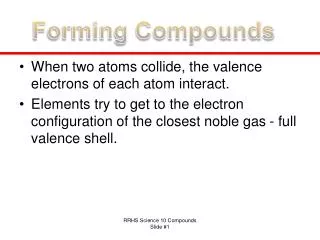
Compounds • pure substances containing two or more elements in fixed proportions • when atoms collide, valence electrons interact to make valence shells stable (like that of nearest noble gas)
Two Types of Compounds • Atom may gain electrons • Atom may give up electrons IONIC COMPOUND
Atoms may share electrons molecular compound
Ionic Compounds • usually formed by metal with non-metal • metals lose electrons forming cations • non-metals gain electrons forming anions • combine in a ratio to make a neutral compound • overall charge of the compound must be zero • Ionic bond: force of attraction between oppositely charged ions
Properties of Ionic Bonds • Bonds are very strong • Soluble in water • High melting/boiling points • Conduct electricity when dissolved in water • Hard and brittle • Lattice structure
Naming Ionic Compounds • Let’s use POTASSIUM and BROMINE • These form the ionic compound KBr
Step 1: Name the metal ion first • Potassium • Step 2: Name the non-metal ion second • Bromide • Step 3: Name the ionic compound by combining ion names • Potassium bromide
Together … • Formulas of ionic compounds often contain numbers • These numbers are called subscripts – let’s ignore for now • Try … ZnF2
Practice • CaS • MgCl2 • Na3P • LiBr • CaI2 • Al2O3 • Mg3N2