
Futures Contracts
E N D
Presentation Transcript
14 Futures Contracts
Futures Contracts • Our goal in this chapter is to discuss the basics of futures contracts and how their prices are quoted in the financial press. • We will also look at how futures contracts are used (speculation and hedging) and how futures accounts are maintained.
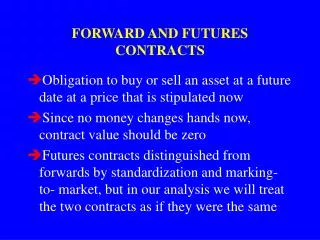
Forward Contract Basics, I. • We begin by discussing a forward contract. • A forward contract is an agreement made today between a buyer and a seller who are obligatedto complete a transaction at a date in the future. • The buyer and the seller know each other. • The negotiation process leads to customized agreements. • What to trade; Where to trade; When to trade; How much to trade—all can be customized.
Forward Contract Basics, II. • Important: The price at which the trade will occur is also determined when the agreement is made. • This price is known as the forward price. • One party faces default risk, because the other party might have an incentive to default on the contract. • To cancel the contract, both parties must agree. • One side might have to make a dollar payment to the other to get the other side to agree to cancel the contract.
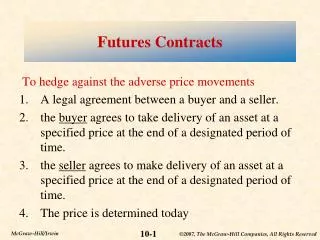
Futures Contract Basics, I. • A Futures contract is an agreement made today between a buyer and a seller who are obligatedto complete a transaction at a date in the future. • The buyer and the seller do notknow each other. • The terms of a futures contract are standardized. • What to trade; Where to trade; When to trade; How much to trade; what quality of good to trade—all standardized under the terms of the futures contract.
Futures Contract Basics, II. • The price at which the trade will occur is determined "in the pit." • This price is known as the futures price. • No one faces default risk, even if the other party has an incentive to default on the contract. • The Futures Exchange where the contract is traded guarantees each trade—no default is possible. • To cancel the contract, an offsetting trade is made "in the pit." • The trader of a futures contract may experience a gain or a loss.
Organized Futures Exchanges • Established in 1848, the Chicago Board of Trade (CBOT) is the oldest organized futures exchange in the United States. • Other Major Exchanges: • New York Mercantile Exchange (1872) • Chicago Mercantile Exchange (1874) • Kansas City Board of Trade (1882) • Early in their history, these exchanges only traded contracts in storable agricultural commodities (i.e., oats, corn, wheat). • Agricultural futures contracts still make up an important part of organized futures exchanges. • Over the past two years or so the CME, CBOT and NYMEX have merged to become the CME Group.
Financial Futures • Financial futures are also an important part of organized futures exchanges. • Some important milestones: • Currency futures trading, 1972. • Gold futures trading, 1974. • Actually, on December 31, 1974. • The very day that ownership of gold by U.S. citizens was legalized. • U.S. Treasury bill futures, 1976. • U.S. Treasury bond futures, 1977. • Eurodollar futures, 1981. • Stock Index futures, 1982. • Today, financial futures are so successful that they constitute the bulk of all futures trading.
Futures Contracts Basics • In general, futures contracts must stipulate at least the following five terms: • The identity of the underlying commodity or financial instrument. • The futures contract size. • The futures maturity date, also called the expiration date. • The delivery or settlement procedure. • The futures price.
Why Futures? • A futures contract represents a zero-sum game between a buyer and a seller. • Gains realized by the buyer are offset by losses realized by the seller (and vice-versa). • The futures exchanges keep track of the gains and losses every day. • Futures contracts are used for hedging and speculation. • Hedging and speculating are complementary activities. • Hedgers shift price risk to speculators. • Speculators absorb price risk.
Speculating with Futures, Long • Buying a futures contract (today) is often referred to as “going long,” or establishing a long position. • Recall: Each futures contract has an expiration date. • Every day before expiration, a new futures price is established. • If this new price is higher than the previous day’s price, the holder of a longfutures contract position profitsfrom this futures price increase. • If this new price is lower than the previous day’s price, the holder of a long futures contract position loses from this futures price decrease.
Speculating with Futures, Short • Selling a futures contract (today) is often called “going short,” or establishing a short position. • Recall: Each futures contract has an expiration date. • Every day before expiration, a new futures price is established. • If this new price is higher than the previous day’s price, the holder of a shortfutures contract position loses from this futures price increase. • If this new price is lower than the previous day’s price, the holder of a shortfutures contract position profits from this futures price decrease.
Hedging with Futures • A hedgertrades futures contracts to transfer price risk. • Hedgers transfer price risk by adding a futures contract position that is opposite of an existing position in the commodity or financial instrument.
Hedging with Futures, Short Hedge • A company has a large inventory that will be sold at a future date. • So, the company will suffer losses if the value of the inventory falls. • Suppose the company wants to protect the value of their inventory. • Selling futures contracts today offsets potential declines in the value of the inventory. • The act of selling futures contracts to protect from falling prices is called short hedging.
Hedging with Futures, Long Hedge • A company needs to buy a commodity at a future date. • The company will suffer “losses” if the price of the commodity increases before then. (That is, they paid more than the could have) • Suppose the company wants to "fix" the price that they will pay for the commodity. • Buying futures contracts today offsets potential increases in the price of the commodity. • The act of buying futures contracts to protect from rising prices is called long hedging.
Futures Trading Accounts • A futures exchange, like a stock exchange, allows only exchange members to trade on the exchange. • Exchange members may be firms or individuals trading for their own accounts, or they may be brokerage firms handling trades for customers. • For a list of futures brokers: http://www.deepdiscountfutures.com/
Important Aspects of Futures Trading Accounts • The important aspects about futures trading accounts: • Margin is required - initial margin as well as maintenance margin. • The contract values are marked to market on a daily basis, and a margin call will be issued if necessary. • A futures position can be closed out at any time. This is done by entering a reverse trade.
Futures Trading Accounts, Cont. • Initial Margin (which is a “good faith” deposit) is required when a futures position is first established. • Initial Margin levels: • Depend on the price volatility of the underlying asset • Can differ by type of trader • When the price of the underlying asset changes, the futures exchange adds or subtracts money from trading accounts (this is called marking to market). • When the balance in the trading account gets "too low," it violates maintenance margin levels, and a margin call is issued. • A margin call is simply a stern request by the broker that more money be deposited into the trading account.
Stock Index Futures • There are a number of futures contracts on stock market indexes. Important ones include: • The S&P 500 • The Dow Jones Industrial Average • Because of the difficulty of actual delivery, stock index futures are usually cash settled. • That is, when the futures contract expires, there is no delivery of shares of stock. • Instead, the positions are "marked-to-market" for the last time, and the contract no longer exists.
Single Stock Futures • OneChicago began trading single stock futures in November 2002. • OneChicago is a joint venture of the Chicago Board Options Exchange (CBOE), Chicago Mercantile Exchange, Inc. (CME), and the Chicago Board of Trade (CBOT). • Single Stock Futures (SSF) contracts are listed on 1200 stocks • The underlying asset for the single stock futures is 100 Shares of common stock. • Unlike stock indexes, shares are delivered at futures expiration. • The exchange also has contracts on Narrow Based Indexes (NBIs) with 9 or fewer stocks in each index and broader indexes and sectors.
Cross Hedging • Cross-hedgingrefers to hedging a particular spot position with futures contracts on a related, but notidentical, commodity or financial instrument. • For example, you decide to protect your stock portfolio from a fall in value by selling some S&P 500 stock index futures contracts. • This is a “cross-hedge” if changes in your portfolio value do not move in tandem with changes in the value of the S&P 500 index.
Hedging Stock Portfolios with Stock Index Futures • There is a formula for calculating the number of stock index futures contracts needed to hedge a portfolio. • Suppose the beta of a portfolio, bP, is calculated using the S&P 500 Index as the benchmark portfolio. • We need to know the dollar value of the portfolio to be hedged, VP. • We need the dollar value of one S&P 500 futures contract, VF (which is 250 × S&P 500 index futures price) • The formula: • For smaller portfolios we can also use the mini S&P 500 futures contract.
Readings • Ch. 14, pages 449 – 460, 464 – 465, 466 - 467