Heat Changes in Temperature and Phase Specific Heat Capacity
170 likes | 184 Vues
Learn about specific heat capacity and how it relates to changes in temperature and phase. Discover the concepts of latent heat and heat of fusion and vaporization.


Heat Changes in Temperature and Phase Specific Heat Capacity
E N D
Presentation Transcript
Heat Changes in Temperature and Phase
Specific Heat Capacity • Specific heat capacity – the quantity of energy needed to raise the temperature of 1 kg of a substance by 1°C at constant pressure • How much energy is needed to change the temperature of something • Different for every substance • Specific heat capacity = energy transferred as heat / (mass * change in temperature) • cp = Q/(mΔT) • The subscript p means that the pressure is constant • We will assume this during our calculations • Q = mcΔT
Specific Heat Capacity • When the temperature increases, ΔT and Q are positive • When the temperature decreases, ΔT and Q are negative • T can be in either °C or K • 1°C is the same as 1K • Q is in Joules • c is in J/(kg*°C ) or J/(kg* K)
Specific Heat Capacity • To determine a specific heat capacity, you must compare the unknown substance to a known substance such as water • The energy absorbed or lost by the water must be equal to the energy absorbed or lost by the unknown • Calorimetry – an experimental procedure used to measure the energy transferred from one substance to another as heat • The container of the unknown is called a calorimeter • Qw = -Qx • cp,wmwΔTw = -cp,xmxΔTx
Latent Heat • Phase change – the physical change of a substance from one state (solid, liquid, or gas) to another at constant temperature and pressure • Energy is required for a change of state • Must be added to go to a higher energy state (gases, plasmas) • Released when moving to a lower energy state (solids)
Latent Heat • This energy changes the internal energy of the substance not the temperature • Temperature will not change until all of the substance has completely undergone the phase change
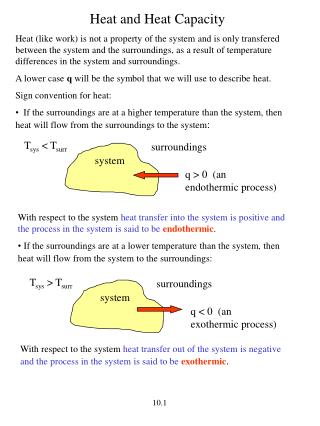
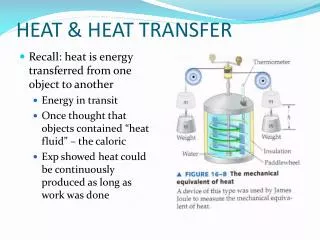
Latent Heat • Heat is the energy that is exchanged between two objects at different temperatures or between two objects at the same temperature when one of them is undergoing a phase change • Atoms and molecules prefer to maintain a distance from similar atoms or molecules that correspond to a minimum potential energy
Latent Heat • As heat is added to a substance its particles increase in energy • Once enough energy has been added, bonds holding the atoms or molecules break • Resulting in phase changes or chemical reactions if enough energy is added
Latent Heat • Energy required to melt a substance goes into rearranging the molecules of that substance • Heat of fusion – the energy per unit mass transferred in order to change a substance from solid to liquid or from liquid to solid at constant temperature and pressure
Latent Heat • Energy required to vaporize a substance mostly goes into separating the molecules • Heat of vaporization – the energy per unit mass transferred in order to change a substance from liquid to vapor or from vapor to liquid at constant temperature and pressure • Latent heat – the energy per unit mass that is transferred during a phase change of a substance
Latent Heat • Energy transferred as heat during a phase change = mass * latent heat • Q = mL • Lf – latent heat of fusion • Lv – latent heat of vaporization