Energy Transformation and Conservation in Helicopter Food Supply Drop to an Isolated Village
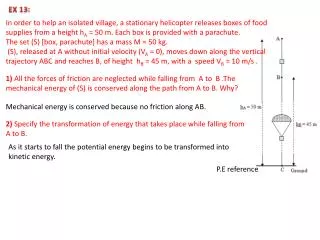
A stationary helicopter releases food supply boxes from a height of 50 m using parachutes to assist an isolated village. Each box, with a mass of 50 kg, falls along a vertical trajectory. The mechanical energy of the system is conserved between points A and B due to the absence of friction. As the box falls, potential energy converts to kinetic energy, and upon reaching B, the parachute opens, allowing a constant speed descent to point C. If a parachute fails to open, energy conservation principles help calculate the new impact speed at C.

Energy Transformation and Conservation in Helicopter Food Supply Drop to an Isolated Village
E N D
Presentation Transcript
EX 13: In order to help an isolated village, a stationary helicopter releases boxes of food supplies from a height hA = 50 m. Each box is provided with a parachute. The set (S) [box, parachute] has a mass M = 50 kg. (S), released at A without initial velocity (VA = 0), moves down along the vertical trajectory ABC and reaches B, of height hB = 45 m, with a speed VB = 10 m/s . 1) All the forces of friction are neglected while falling from A to B .The mechanical energy of (S) is conserved along the path from A to B. Why? Mechanical energy is conserved because no friction along AB. 2) Specify the transformation of energy that takes place while falling from A to B. As it starts to fall the potential energy begins to be transformedinto kinetic energy. P.E reference
In order to help an isolated village, a stationary helicopter releases boxes of food supplies from a height hA = 50 m. Each box is provided with a parachute. The set (S) [box, parachute] has a mass M = 50 kg. (S), released at A without initial velocity (VA = 0), moves down along the vertical trajectory ABC and reaches B, of height hB = 45 m, with a speed VB = 10 m/s . • 3)Upon reaching B, the parachute opens and the set (S) continues its fall at a constant speed of 10m/s until it reaches C (VC =10 m/s). • Find the decrease in the mechanical energy of (S) when it passes from B to C.
In order to help an isolated village, a stationary helicopter releases boxes of food supplies from a height hA = 50 m. Each box is provided with a parachute. The set (S) [box, parachute] has a mass M = 50 kg. (S), released at A without initial velocity (VA = 0), moves down along the vertical trajectory ABC and reaches B, of height hB = 45 m, with a speed VB = 10 m/s . • 4) How does this loss of energy appear? It appears in the form of heat energy (thermal heat) 4) One of the parachutes did not open while falling from A to C. Determine, in this case, the speed with which this box reaches C. Mechanical energy is conserved because no friction along BC then : 2
5- What can you conclude about the role of the parachute in the fall of the box? • The parachute reduces the speed of the box upon impact with the ground.