Understanding Velocity and Acceleration: Rates of Change and Applications
100 likes | 247 Vues
This chapter delves into the concept of rates of change, specifically focusing on velocity and acceleration as derivatives that describe motion. It provides concrete examples, such as population growth and water flow rates, and illustrates how these concepts apply to an object's motion in a straight line. Through position functions, average velocity calculations, and instantaneous velocities, we analyze scenarios including a diver's jump and a coin drop from a building, exploring their positions and velocities at specified intervals. This foundation is essential for understanding dynamic systems in physics.


Understanding Velocity and Acceleration: Rates of Change and Applications
E N D
Presentation Transcript
Velocity and Acceleration Chapter 2
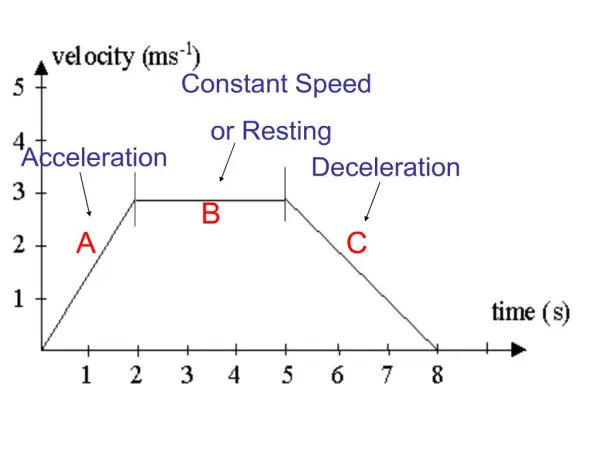
Rates of Change • The derivative can be used to determine the rate of change in one variable with respect to another. Applications involving rates of change occur in the following examples: population growth rates, water flow rates, velocity and acceleration. • A common use for rate of change is to describe the motion of an object moving in a straight line.
The function s that gives the position (relative to the origin) of an object as a function of time t is called a position function. If, over a period of time ∆t, the object changes its position by the amount then by the familiar formula the average velocity is
If a billiard ball is dropped from a height of 100 feet, its height s at time t is given by the position function s(t) = -16t2 + 100 where s is measured in feet and t is measured in seconds. Find the average velocity over the interval [1, 2].
The average velocity between t1and t2 is the slope of the secant line, and the instantaneous velocity at t1is the slope of the tangent line. • If s = s(t) is the position function for an object along a straight line, the velocity of the object at time t is
The position of a free-falling object (neglecting air resistance) under the influence of gravity can be represented by the equation s(t)=½gt2 + v0t + s0 where s0 is the initial height of the object, v0 is the initial velocity of the object, and g is the acceleration due to gravity.
At time t=0, a diver jumps from a platform diving board that is 32 feet above the water. The position of the diver is given by s(t)= -16t2 + 16t +32 where s is measured in feet and t is measured in seconds. • When does the diver hit the water? • What is the diver’s velocity at impact?
A silver dollar is dropped from the top of a building that is 1362 feet tall. • Determine the position, velocity and acceleration functions for the coin. • Determine the average velocity on the interval [1,2]. • Find the instantaneous velocities at t=1 and t=2. • Find the time required for the coin to reach the ground. • Find the velocity of the coin at impact. • Find the acceleration at t=1.2