Theorems and Lemmas on Spanning Trees in Graph Theory
Explore key theorems such as Kirchhoff's and Binet-Cauchy Lemmas related to spanning trees in undirected graphs, adjacency matrices, and incidence matrices in graph theory. Understand the computational complexity and applications.

Theorems and Lemmas on Spanning Trees in Graph Theory
E N D
Presentation Transcript
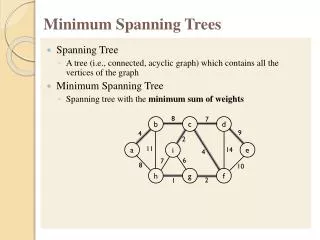
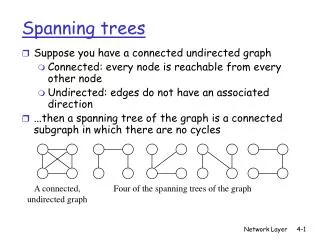
[Section 1.1] Spanning Trees • Recall the definitions of: • graphs, the vertex set V={0,1,2,…,n-1}, the edge set E • n = |V|, m = |E| • adjacency matrix • spanning tree
[Section 1.1] Spanning Trees Thm 1.1 (Kirchhoff): Let A be the adjacency matrix of an undirected graph and D be the diagonal matrix with the degrees of vertices on its diagonal. Then, for every i2 {0,1,2,…,n-1}: # spanning trees of G = det (D-A)ii Where (D-A)ii is an (n-1)x(n-1) submatrix obtained from D-A by removing the i-th row and the i-th column.
[Section 1.1] Spanning Trees Thm (Kirchhoff): Let A be the adjacency matrix of an undirected graph and D be the diagonal matrix with the degrees of vertices on its diagonal. Then, for every i2 {0,1,2,…,n-1}: # spanning trees of G = det (D-A)ii Where (D-A)ii is an (n-1)x(n-1) submatrix obtained from D-A by removing the i-th row and the i-th column. Note: determinant can be computed in time O(n3)
[Section 1.1] Spanning Trees Lemma (Binet-Cauchy): If A is an (rxm) matrix and B is an (mxr) matrix, then: det(A.B) = Sµ [m], |S|=r det(A*S).det(BS*) Where A*S is the (rxr) matrix obtained from A by keeping only the columns in S, and BS* is the (rxr) matrix obtained from B by keeping only the rows in S.
[Section 1.1] Spanning Trees Def: Incidence matrix of a directed graph H: an (nxm) matrix N=(ºve) such that: +1 if e starts at v ºve = -1 if e ends at v 0 o\w
[Section 1.1] Spanning Trees Fact 1.6: rank N = n - # weakly connected components of H
[Section 1.1] Spanning Trees Fact 1.6: rank N = n - # weakly connected components of H
[Section 1.1] Spanning Trees Fact 1.7: If B is a square matrix with entries in {+1,-1,0} and every column has at most one +1 and at most one -1. Then, det(B) is +1, -1, or 0.
[Section 1.1] Spanning Trees Thm 1.1 (Kirchhoff): # spanning trees = det (D-A)ii Proof:
[Section 1.1] Spanning Trees Thm 1.1 (Kirchhoff): # spanning trees = det (D-A)ii Proof: