Understanding Photosynthesis: The Light and Dark Reactions in Plants
110 likes | 232 Vues
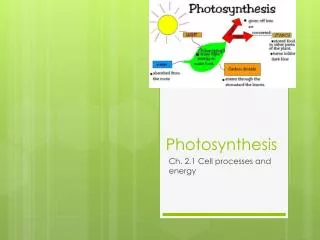
Photosynthesis is the process by which green plants convert light energy into chemical energy. It occurs in chloroplasts, which contain thylakoids where light-dependent reactions take place. These reactions produce ATP and split water to provide hydrogen ions for carbon fixation. The light-independent phase, known as the Calvin Cycle, occurs continuously in daylight and can also function in the dark. Chlorophyll, which captures light energy, comprises various pigments. This article explores the mechanisms of photosynthesis, including the role of ATP, NADP, and RUBISCO in glucose production.


Understanding Photosynthesis: The Light and Dark Reactions in Plants
E N D
Presentation Transcript
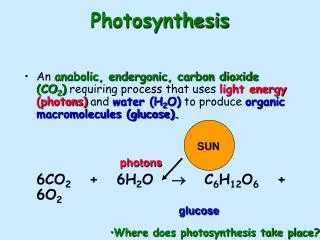
Photosynthesis in Plants • What is the simple word equation for photosynthesis?
Chloroplasts Thylakoids are a phospholipidbilayer membrane-bound compartment. A granum is a stack of thylakoids folded on top of one another. The stroma is the fluid space within the chloroplast. The lumen is the fluid filled space within a thylakoid. An average green plant cell has between 10 – 50 chloroplast
Chlorophyll • Chlorophyll is actually made up of 5 pigments • Chlorophyll a & b • Carotenoids (carotene and xanthophyll) • Phaeophytin (a grey breakdown product of the others)
There are 2 distinct chlorophyll complexes • Photosystem I (PSI) • Photosystem II (PSII) • Each system has a different combination of pigments • They therefore absorb light in different areas of the spectrum • PSI absorbs around 700 nm • PSII absorbs around 680 nm • Each system has a different role in photosynthesis
Biochemistry of Photosynthesis • Photosynthesis is a two stage process involving a series of reactions. • Light-dependent stage can only take place during daylight. • It produces products which are used by the light-independent stages. • The whole process occurs all the time during daylight hours. But the light-independent stage can also occur in the dark.
Light-Dependent • Takes place on thylakoid membranes • 2 functions: • Produce ATP • Split water in a photochemical reaction providing hydrogen ions to reduce CO2 and make carbohydrates • Light is made of photons, photons hit chlorophyll and excite them (give them more energy) • excited electrons are picked up by electron acceptors • ATP can then be made by photophosphorylationvia an electron transport chain.
Non-Cyclic Photophosphorylation NADP (electron acceptor) +2H+ Reduced NADP (used in light-independent reaction) Electron transport chain
Light-independent Stage CO2 Glucose RUBISCO Calvin Cycle