Chemistry Class Update - November 20, 2013
300 likes | 320 Vues
Stay informed about the latest assignments, tests, and topics covered in your chemistry class on November 20, 2013. Learn about energy change, thermochemistry, and reaction rates.


Chemistry Class Update - November 20, 2013
E N D
Presentation Transcript
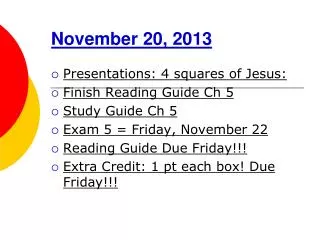
November 20, 2013 When the bell rings, voice at ZERO and all electronics away including headphones. TURN IN YOUR LAB including POST-QUESTIONS and any late Hw. TURN IN HW #13. Have your vocab out on your desk. DO NOW: Around the room there are 7 stations. You are required to get the information at these stations down. Keep your volume at a level 1. You have 15min from the bell.
Tutoring • Thursday afterschool in 710 (2:30-3:30pm)
STEM PROJECT • Reschedule today? • Afterschool or at home • Google drive
Homework 11-20-13 • Vocab column #2** • HW assignment #14** **graded
Notebook Check 11-22-13 • Stoichiometry Island Flow Chart • Anticipation Guide Solutions (just the guide, not the reading) • Pink Solutions Vocabulary (both parts) • Colligative Properties Foldable
Week of 11-18-13 • November 18: Solubility Lab Solubility Quiz Finish Solubility HW: Assignment #12, Finish lab post-questions • November 19: Energy Change and ThermoChemistry HW: Assignment #13, vocab column #1 • November 20: Energy Change and ThermoChemistry HW: Assignment #14, Vocab column #2 test corrections due Friday 11-22-13 • November 21: Energy and Thermochemistry Thermochem quiz HW: Vocab column #3, study for solutions test • November 22: Solutions Test , Notebook Check HW: ClEvR Report due Tuesday 11-26-13
Objectives • SWBAT • Explain the factors that affect the rate of a reaction (Temperature, concentration, particle size, and presence of a catalyst)
Rate of Reaction Demo • Glow Sticks
Exothermic Processes Processes in which energy is released as it proceeds, and surroundings become warmer Reactants Products + energy
Endothermic Processes Processes in which energy is absorbed as it proceeds, and surroundings become colder Reactants + energy Products
Reaction Rates: 2NO2(g) 2NO(g) + O2(g) 1. Can measure disappearance of reactants 2. Can measure appearance of products 3. Are proportional stoichiometrically
The Reaction Mechanism • Thereaction mechanism is the series of steps by which a chemical reaction occurs. • A chemical equation does not tell us how reactants become products; it is a summary of the overall process. Reactants Products The sign has represents the reaction mechanism, but gives no indication of the steps in the mechanism
The Rate-Determining Step In a multi-step reaction, the slowest step is the rate-determining step. It therefore determines the rate of reaction.
Factors Affecting Rate • Temperature Increasing temperature always increases the rate of a reaction. • Surface Area Increasing surface area increases the rate of a reaction • Concentration Increasing concentration USUALLY increases the rate of a reaction • Presence of Catalysts
Catalysis • Catalyst: A substance that speeds up a reaction by lowering activation energy • Enzyme: A large molecule (usually a protein) that catalyzes biological reactions. • Homogeneous catalyst: Present in the same phase as the reacting molecules. • Heterogeneous catalyst: Present in a different phase than the reacting molecules.
Energy Heat (Enthalpy) Change, ΔH • Energy is the capacity to do work, and can take many forms • Potential energy is stored energy or the energy of position • Kinetic energy is the energy of motion • Thermal energy (heat) is an outward manifestation of movement at the atomic level Definition:The amount of heat energy released or absorbed during a process.
Units for Measuring Heat The Joule is the SI system unit for measuring heat: The calorie is the heat required to raise the temperature of 1 gram of water by 1 Celsius degree
Exothermic Processes Processes in which energy is released as it proceeds, and surroundings become warmer Reactants Products + energy
Endothermic Processes Processes in which energy is absorbed as it proceeds, and surroundings become colder Reactants + energy Products
Water phase changes constant Temperature remains __________ during a phase change.
Phase Change Diagram Processes occur by addition of energy Processes occur by removal of energy
Phase Diagram • Represents phases as a function of temperature and pressure. • Critical temperature: temperature above which the vapor can not be liquefied. • Critical pressure: pressure required to liquefy AT the critical temperature. • Critical point: critical temperature and pressure (for water, Tc = 374°C and 218 atm).