Understanding the Chain Rule in Calculus: Composite Functions and Derivatives
This guide explores the Chain Rule, an essential concept in calculus that explains how to differentiate composite functions. It highlights the relationships between inside and outside functions, demonstrating how a small change in one variable impacts another. Through step-by-step examples, it illustrates the process of applying the Chain Rule to various functions, emphasizing its importance in finding derivatives that cannot be calculated using basic rules alone. Practical exercises are included to reinforce learning and ensure understanding of the topic.


Understanding the Chain Rule in Calculus: Composite Functions and Derivatives
E N D
Presentation Transcript
The Problem • Complex Functions • Why? not all derivatives can be found through the use of the power, product, and quotient rules
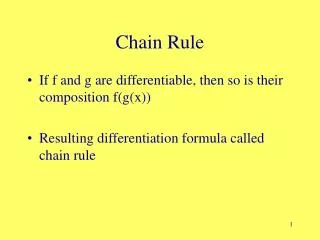
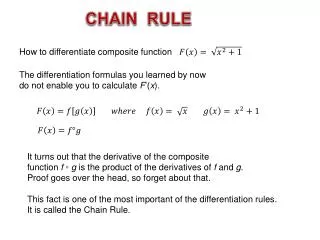
Working To A Solution • Composite function f(g(x)) f is the outside function, g is the inside function • z=g(x), y=f(z), and y=f(g(x)) • Therefore, a small change in x leads to a small change in z a small change in z leads to a small change in y
Working To A Solution cont. • Therefore, (∆y/∆x) = (∆y/∆z) (∆z/∆x) • Since (dy/dx)=limx0 (∆y/∆x) (dy/dx) = (dy/dz) (dz/dx) • This is known as “The Chain Rule”
Pushing Further • Looking back, z=g(x), y=f(z), and y=f(g(x)) • Since (dy/dz)=f’(z) and (dz/dx)=g’(x) (d/dx) f(g(x)) = f’(z) × g’(x) • This allows us to rewrite the chain rule as • (d/dx) f(g(x)) = f’(g(x)) × g’(x) • Therefore, the derivative of a composite function equals the derivative of the outside function times the derivative of the inside function
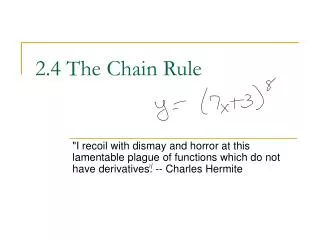
Example:f(x) = [ (x^3) + 2x + 1 ]^3 • inside function = z = g(x) = (x^3) + 2x + 1 • outside function = f(z) = z^3 • g’(x) = (3x^2) + 2 • f’(z) = 3[z]^2 • (d/dx) f(g(x)) = 3 [ (3x^2) + 2 ] [ z]^2 = [ (9x^2) + 6 ] [ (x^3) + 2x + 1 ]^2
Examplef(x) = e^(4x^2) • inside function = z = g(x) = 4x^2 • outside function = f(z) = e^z • g’(x) = 8x • f’(z) = e^z • (d/dx) f(g(x)) = 8xe^z = 8xe^(4x^2)
Examplef(x) = [(x^3) + 1]^(1/2) • Inside function = z = g(x) = (x^3) + 1 • outside function = f(z) = z^(1/2) • g’(x) = 3x^2 • f’(z) = (1/2)z^(-1/2) • (d/dx) f(g(x)) = (3x^2) (1/2)z^(-1/2) = [(3/2)x^2] [(x^3) + 1]^(-1/2)
Homework • Chapter 3.4Problems: 1,2,4,5,6,7,8,10,11,12,15,16,18,20,27 • Remember to show all work. Turn in the assignment before the beginning of the next class period.
Sources • Slideshow created using Microsoft PowerPoint • Clipart and themes supplied through Microsoft PowerPoint • Mathematics reference and notation from “Calculus: Single and Multivariable” 4th edition, by Hughes-Hallet|Gleason|McCallum|et al.