
Data Types in Programming Languages
E N D
Presentation Transcript
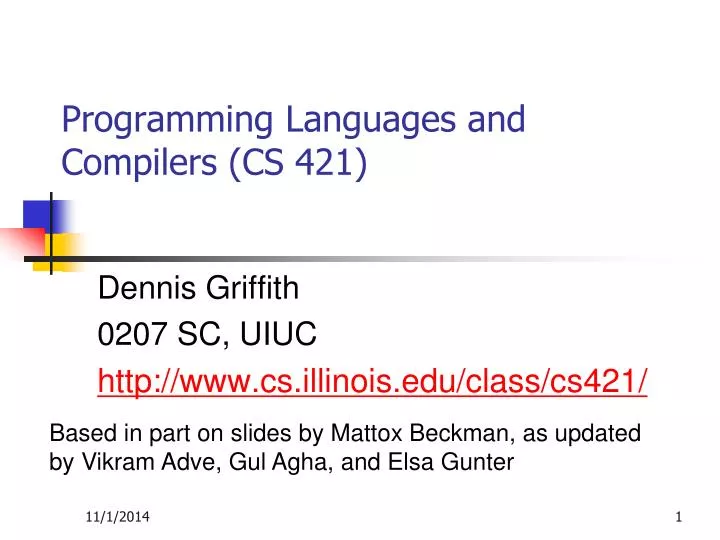
Programming Languages and Compilers (CS 421) Dennis Griffith 0207 SC, UIUC http://www.cs.illinois.edu/class/cs421/ Based in part on slides by Mattox Beckman, as updated by Vikram Adve, Gul Agha, and Elsa Gunter
Why Data Types? • Data types play a key role in: • Data abstraction in the design of programs • Type checking in the analysis of programs • Compile-time code generation in the translation and execution of programs
Terminology • Type: A type t defines a set of possible data values • E.g. short in C is {x| 215 - 1 x -215} • A value in this set is said to have type t • Type system: rules of a language assigning types to expressions
Types as Specifications • Types describe properties • Different type systems describe different properties, eg • Data is read-write versus read-only • Operation has authority to access data • Data came from “right” source • Operation might or could not raise an exception • Common type systems focus on types describing same data layout and access methods
Sound Type System • If an expression is assigned type t, and it evaluates to a value v, then v is in the set of values defined by t • SML, OCAML, Scheme and Ada have sound type systems • Most implementations of C and C++ do not
Strongly Typed Language • When no application of an operator to arguments can lead to a run-time type error, language is strongly typed • Eg: 1 + 2.3;; • Depends on definition of “type error”
Strongly Typed Language • C++ claimed to be “strongly typed”, but • Union types allow creating a value at one type and using it at another • Type coercions may cause unexpected (undesirable) effects • No array bounds check (in fact, no runtime checks at all) • SML, OCAML “strongly typed” but still must do dynamic array bounds checks, runtime type case analysis, and other checks
Static vs Dynamic Types • Static type: type assigned to an expression at compile time • Dynamic type: type assigned to a storage location at run time • Statically typed language: static type assigned to every expression at compile time • Dynamically typed language: type of an expression determined at run time
Type Checking • When is op(arg1,…,argn) allowed? • Type checkingassures that operations are applied to the right number of arguments of the right types • Right type may mean same type as was specified, or may mean that there is a predefined implicit coercion that will be applied • Used to resolve overloaded operations
Type Checking • Type checking may be done staticallyat compile timeor dynamically at run time • Dynamically typed languages (e.g., LISP, Python) do only dynamic type checking • Statically typed languages can do most type checking statically
Dynamic Type Checking • Performed at run-time before each operation is applied • Types of variables and operations left unspecified until run-time • Same variable may be used at different types
Dynamic Type Checking • Data object must contain type information • Errors aren’t detected until violating application is executed (maybe years after the code was written)
Static Type Checking • Performed after parsing, before code generation • Type of every variable and signature of every operator must be known at compile time
Static Type Checking • Can eliminate need to store type information in data object if no dynamic type checking is needed • Catches many programming errors at earliest point • Can’t check types that depend on dynamically computed values • Eg: array bounds
Static Type Checking • Typically places restrictions on languages • Garbage collection • References instead of pointers • All variables initialized when created • Variable only used at one type • Union types allow for work-arounds, but effectively introduce dynamic type checks
Type Declarations • Type declarations: explicit assignment of types to variables (signatures to functions) in the code of a program • Must be checked in a strongly typed language • Often not necessary for strong typing or even static typing (depends on the type system)
Type Inference • Type inference: A program analysis to assign a type to an expression from the program context of the expression • Fully static type inference first introduced by Robin Miller in ML • Haskell, OCAML, SML use type inference • Records are a problem for type inference
Format of Type Judgments • A type judgement has the form |- exp : • is a typing environment • Supplies the types of variables and functions • is a list of the form [ x : , . . . ] • exp is a program expression • is a type to be assigned to exp • |- pronounced “turnstyle”, or “entails” (or “satisfies”)
Example Valid Type Judgments • [ ] |- true or false : bool • [ x : int] |- x + 3 : int • [ p : int -> string ] |- p(5) : string
Format of Typing Rules Assumptions 1 |- exp1 : 1 . . . n |- expn : n |- exp : Conclusion • Idea: Type of expression determined by type of components • Rule without assumptions is called an axiom • may be omitted when empty
Format of Typing Rules Assumptions 1 |- exp1 : 1 . . . n |- expn : n |- exp : Conclusion • , exp, are parameterized environments, expressions and types - i.e. may contain meta-variables
Axioms - Constants |- n : int (assuming n is an integer constant) |- true : bool |- false : bool • These rules are true with any typing environment • n is a meta-variable
Axioms - Variables Notation: Let (x) = if x : and there is no x : to the left of x : in Variable axiom: |- x : if (x) =
Simple Rules - Arithmetic Primitive operators ( { +, -, *, …}): |- e1 : int |- e2 : int |- e1 e2 : int Relations ( ˜ { < , > , =, <=, >= }): |- e1 : int |- e2 : int |- e1˜ e2 :bool
Simple Rules - Booleans Connectives |- e1 : bool |- e2 : bool |- e1 && e2 : bool |- e1 : bool |- e2 : bool |- e1 || e2 : bool
Simple Example • Let = [ x:int ; y:bool] • Show |- y || (x + 3 > 6) : bool • Start building the proof tree from the bottom up ? |- y || (x + 3 > 6) : bool
Simple Example • Let = [ x:int ; y:bool] • Show |- y || (x + 3 > 6) : bool • Which rule has this as a conclusion? ? |- y || (x + 3 > 6) : bool
Simple Example • Let = [ x:int ; y:bool] • Show |- y || (x + 3 > 6) : bool • Booleans: || |- y : bool |- x + 3 > 6 : bool |- y || (x + 3 > 6) : bool
Simple Example • Let = [ x:int ; y:bool] • Show |- y || (x + 3 > 6) : bool • Pick an assumption to prove ? |- y : bool |- x + 3 > 6 : bool |- y || (x + 3 > 6) : bool
Simple Example • Let = [ x:int ; y:bool] • Show |- y || (x + 3 > 6) : bool • Which rule has this as a conclusion? ? |- y : bool |- x + 3 > 6 : bool |- y || (x + 3 > 6) : bool
Simple Example • Let = [ x:int ; y:bool] • Show |- y || (x + 3 > 6) : bool • Axiom for variables |- y : bool |- x + 3 > 6 : bool |- y || (x + 3 > 6) : bool
Simple Example • Let = [ x:int ; y:bool] • Show |- y || (x + 3 > 6) : bool • Pick an assumption to prove ? |- y : bool |- x + 3 > 6 : bool |- y || (x + 3 > 6) : bool
Simple Example • Let = [ x:int ; y:bool] • Show |- y || (x + 3 > 6) : bool • Which rule has this as a conclusion? ? |- y : bool |- x + 3 > 6 : bool |- y || (x + 3 > 6) : bool
Simple Example • Let = [ x:int ; y:bool] • Show |- y || (x + 3 > 6) : bool • Arithmetic relations |- x + 3 : int |- 6 : int |- y : bool |- x + 3 > 6 : bool |- y || (x + 3 > 6) : bool
Simple Example • Let = [ x:int ; y:bool] • Show |- y || (x + 3 > 6) : bool • Pick an assumption to prove ? |- x + 3 : int |- 6 : int |- y : bool |- x + 3 > 6 : bool |- y || (x + 3 > 6) : bool
Simple Example • Let = [ x:int ; y:bool] • Show |- y || (x + 3 > 6) : bool • Which rule has this as a conclusion? ? |- x + 3 : int |- 6 : int |- y : bool |- x + 3 > 6 : bool |- y || (x + 3 > 6) : bool
Simple Example • Let = [ x:int ; y:bool] • Show |- y || (x + 3 > 6) : bool • Axiom for constants |- x + 3 : int |- 6 : int |- y : bool |- x + 3 > 6 : bool |- y || (x + 3 > 6) : bool
Simple Example • Let = [ x:int ; y:bool] • Show |- y || (x + 3 > 6) : bool • Pick an assumption to prove ? |- x + 3 : int |- 6 : int |- y : bool |- x + 3 > 6 : bool |- y || (x + 3 > 6) : bool
Simple Example • Let = [ x:int ; y:bool] • Show |- y || (x + 3 > 6) : bool • Which rule has this as a conclusion? ? |- x + 3 : int |- 6 : int |- y : bool |- x + 3 > 6 : bool |- y || (x + 3 > 6) : bool
Simple Example • Let = [ x:int ; y:bool] • Show |- y || (x + 3 > 6) : bool • Arithmetic operations |- x : int |- 3 : int |- x + 3 : int |- 6 : int |- y : bool |- x + 3 > 6 : bool |- y || (x + 3 > 6) : bool
Simple Example • Let = [ x:int ; y:bool] • Show |- y || (x + 3 > 6) : bool • Pick an assumption to prove ? |- x : int |- 3 : int |- x + 3 : int |- 6 : int |- y : bool |- x + 3 > 6 : bool |- y || (x + 3 > 6) : bool
Simple Example • Let = [ x:int ; y:bool] • Show |- y || (x + 3 > 6) : bool • Which rule has this as a conclusion? ? |- x : int |- 3 : int |- x + 3 : int |- 6 : int |- y : bool |- x + 3 > 6 : bool |- y || (x + 3 > 6) : bool
Simple Example • Let = [ x:int ; y:bool] • Show |- y || (x + 3 > 6) : bool • Axiom for constants |- x : int |- 3 : int |- x + 3 : int |- 6 : int |- y : bool |- x + 3 > 6 : bool |- y || (x + 3 > 6) : bool
Simple Example • Let = [ x:int ; y:bool] • Show |- y || (x + 3 > 6) : bool • Pick an assumption to prove ? |- x : int |- 3 : int |- x + 3 : int |- 6 : int |- y : bool |- x + 3 > 6 : bool |- y || (x + 3 > 6) : bool
Simple Example • Let = [ x:int ; y:bool] • Show |- y || (x + 3 > 6) : bool • Which rule has this as a conclusion? ? |- x : int |- 3 : int |- x + 3 : int |- 6 : int |- y : bool |- x + 3 > 6 : bool |- y || (x + 3 > 6) : bool
Simple Example • Let = [ x:int ; y:bool] • Show |- y || (x + 3 > 6) : bool • Axiom for variables |- x : int |- 3 : int |- x + 3 : int |- 6 : int |- y : bool |- x + 3 > 6 : bool |- y || (x + 3 > 6) : bool
Simple Example • Let = [ x:int ; y:bool] • Show |- y || (x + 3 > 6) : bool • No more assumptions! DONE! |- x : int |- 3 : int |- x + 3 : int |- 6 : int |- y : bool |- x + 3 > 6 : bool |- y || (x + 3 > 6) : bool
Type Variables in Rules • If_then_else rule: |- e1 : bool |- e2 : |- e3 : |- (if e1 then e2 elsee3): • is a type variable (meta-variable) • Can take any type at all • All instances in a rule application must get same type • Then branch, else branch and if_then_else must all have same type
Function Application • Application rule: |- e1 : 1 2 |- e2 : 1 |- (e1e2): 2 • If you have a function expression e1 of type 1 2 applied to an argument of type 1, the resulting expression has type 2
Application Examples |- print_int : int unit |- 5 : int |- (print_int 5) : unit • e1 = print_int, e2 = 5, • 1 = int, 2 = unit |- map print_int : int list unit list |- [3;7] : int list |- (map print_int [3; 7]) : unit list • e1 = map print_int, e2 = [3; 7], • 1 = int list, 2 = unit list