Understanding Triangle Similarity: AA, SAS, and SSS Postulates Explained
120 likes | 253 Vues
Explore the concepts of triangle similarity through the lens of AA, SAS, and SSS postulates. This guide covers how to determine if two polygons are similar, identify congruent angles, and apply similarity statements and scale factors. Learn to compare ratios and understand when triangles are similar based on their angles and side lengths. Engage with practical exercises to reinforce your understanding, along with a homework section to solidify the concepts learned. Perfect for students mastering similarity in geometry.


Understanding Triangle Similarity: AA, SAS, and SSS Postulates Explained
E N D
Presentation Transcript
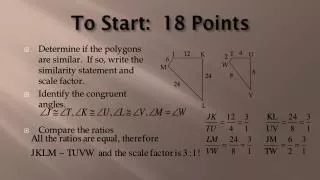
To Start: 18 Points • Determine if the polygons are similar. If so, write the similarity statement and scale factor. • Identify the congruent angles. • Compare the ratios 4 12 T J U K 2 6 W M 8 8 24 24 V L
Chapter 7: Similarity Section 7.3: Proving Triangles Congruent
Using AA∼ Postulate • Are the two triangles similar? Why? • ∠R≅∠V Both are 45o • ∠RSW≅∠VSB Vertical ∠’s So, ∆RSW∼∆VSB AA∼ Postulate
Using AA∼ Postulate • Are the two triangles similar? Why? • ∠L≅∠R Both are 70o • ∠K=180-70-30=80 • ∠P=180-85-70=25 So, ∆RSW and ∆VSB are not Similar
Using AA∼ Postulate YES NO
Verifying Triangle Similarity • Are the triangles similar? If so, write the similarity statement. ∠K≅∠K Reflexive So, ∆KLP∼∆KMN by SAS∼
Verifying Triangle Similarity • Are the triangles similar? If so, write the similarity statement. • All three ratios are equal, so, ∆STU ∼∆VSB by the SSS∼ Theorem.
Using SAS∼ and SSS∼ YES! ∆ABC ∼∆EFG by SSS∼ YES! ∆ALW ∼∆ACE by SAS∼
Homework!! • Page 455: • 1-3, 7-12, 24-26 • 7.3 Worksheet