Download
1 / 14
140 likes | 234 Vues
Explore the need, benefits, and challenges of establishing a standard for peatland projects within the Voluntary Carbon Standard (VCS) AFOLU framework. Learn about peat oxidation, possible project activities, issues, and considerations for emissions reduction and management.

E N D
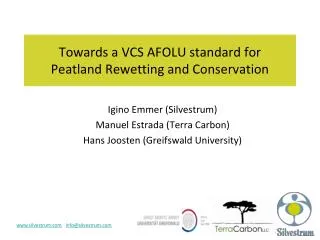
Towards a VCS AFOLU standard for Peatland Rewetting and Conservation Igino Emmer (Silvestrum) Manuel Estrada (Terra Carbon) Hans Joosten (Greifswald University)
Contents • The need for an international ‘peat standard’ • Issues addressed concerning peat
Why develop a standard? • No international standard specific for peat exists • VCS AFOLU includes ARR, ALM, IFM, REDD • Specific guidance for peat IS needed • EB (47th meeting) has rejected NM0297 "Carbon dioxide and methane emissions avoidance from Block-C, Central Kalimantan” • (a) It cannot be ensured that the baseline GHG emissions related to the above mentioned project activities are of anthropogenic nature; • (b) The permanence of the GHG emission reduction cannot be ensured
The Voluntary Carbon Standard (VCS) • Global benchmark standard for voluntary carbon projects • Founded by IETA, the WBCSD and the Climate Group • Designed to be as robust as Kyoto Protocol’s Clean Development Mechanism (CDM), while attempting to reduce costs and bottlenecks • Real, additional, measurable, permanent, independently verified and unique offsets (VCUs)
Why a dedicated AFOLU peat standard? • Peat can represent a carbon pool in ARR, ALM, IFM and REDD, however • The soil carbon pool (peat) is large and potentially dominant vis à vis the other carbon pools • GHG emissions and carbon stock increases largely depend on hydrological conditions • Emission reductions may be achieved that are in a different order of magnitude • Expert group acts as a third party proposing a standard to the VCS
GHG emissions from peatland degradation Peat oxidation due to: • Drainage • Fire • Land uses: • Logging • Agriculture • Peat extraction
VCS-PRC: possible project activities • Peatland rewetting and conservation • ‘Rewetting’ implies the elevation of the average annual water table in drained peatland as a consequence of project activities resulting in reduced net GHG emissions • Additional activities in combination with rewetting and conservation • ARR, ALM, IFM, REDD on peatland • Peatland fire management
Issues regarding PRC project activities • Rewetting: • Resulting CH4, and N2O emissions • Crediting period vs peat depletion time • Hydrological connectivity leakage and permanence • Fire management: • Baseline setting
Accounting for emissions reductions from rewetting • Current knowledge and experience allow for the development of cost effective and environmentally sound approaches to estimate emissions reductions in peatland projects, e.g.: • Water level/CO2 emissions relationships, remote sensing (soil moisture), peat subsidence/CO2 emissions • Applying conservatively high emissions factors in the project case (e.g. CH4) • Discounting uncertainties from the carbon benefits • Conservatively neglect insignificant emissions in the baseline/reductions in the project case to reduce costs
Issues addressed • Drainage before 1 January 2008: no need to prove that drainage was with the intention to generate carbon credits by rewetting • ARR vs ARRp (etc) • Significance peat >5% use both ARR and PRC guidance • Peat is dominant source PRC risk assessment
Issues addressed • Biofuel crop production activities on drained peat are not eligible. Biofuel plus rewetting: use PRC guidance • Drainage of peatland to increase forest productivity is not eligible
Issues addressed • Because reliable onsite monitoring of both N2O emission changes and N input (from artificial fertiliser and manure from grazing animals) is complicated and susceptible to fraud, reducing emissions from N fertilisation on peatland is not eligible for crediting • N-fertiliser application in ALM on peat is not eligible • Upon rewetting, N2O emission will not increase, therefore, ignoring N2O emission implies a conservative approach
Fire management • Only eligible in combination with rewetting • Complicated baseline setting • Pre-defined conservative estimate of emissions from fire in the baseline (25% of total baseline emissions) - conditional • Applying IPCC GL 2006 Tier-3 methods
Thank you Igino Emmer igino.emmer@silvestrum.com Manuel Estrada manuel.estrada@terracarbon.com Hans Joosten joosten@uni-greifswald.de