Download
1 / 10
100 likes | 234 Vues
The Multilateral Fund (MLF) focuses on programs to address ozone depletion, primarily through the phase-out of ozone-depleting substances (ODS) such as CFCs, halons, and methyl bromide. Ozone depletion leads to increased UV radiation, causing health risks like skin cancer and eye cataracts, and affects marine life and agricultural productivity. The MLF, in collaboration with organizations like UNDP and UNEP, has allocated substantial funds for various projects aimed at reducing ODS use and exploring sustainable alternatives, ensuring compliance with the Montreal Protocol.

E N D
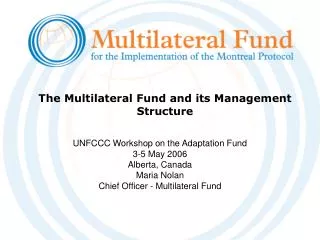
Ozone Programmesunder the Multilateral Fund (MLF) M. Surkov MPU/Chemicals
Ozone hole: Reference: www.nasa.org; www.unep.org
Effects of ozone depletion: • Increased UV radiation is a cancer factor (skin cancer, eye cataracts) • Microscopic life in the surface ocean is susceptible to UV rays, therefore, with increased exposure the food chain is impacted • Crop effects: disintegrating bacteria responsible for nitrogen uptake
Chemicals responsible: • Chlouroflourocarbons (CFCs) • Halons • Carbon tetrachloride, methyl chloroform • Methyl bromide (MBr) • Non-corrosive, non-flammable, performance • Substances find various applications in industries: cooling agents, propellants, fire retardants, solvents, foam-blowing agents, pesticides (MBr)
CFCs phase-out schedules: References: Handbook on the Montreal protocol (seventh edition), UNEP, 2006
UNDP/Montreal Protocol Unit/Chemicals • UNDP was designated by the MLF to work on ozone programmes along with WB, UNEP, and UNIDO • UNDP concentrated its efforts on a diverse set of programmes: investment components (converting production lines/end-user sectors), solvents, foam blowing sectors, fire extinguishing, methyl bromide applications in agriculture • Up to 2007: around US$ 0.5 bln allocated • More than 1,800 different projects since the inception of the programme
Projects in Europe/CIS • GEF supported: • 9 countries with around US$ 23 mln • MLF supported: - 3 countries with around US$ 2 mln
Future of the Montreal Protocol • According to phase-out schedules the use of basic CFCs should be close to ZERO on January 1, 2010. • A few remaining substances: methyl bromide and methyl chloroform will be phased out after the end of 2014 • Essential CFC uses for MDIs • And HCFCs will be phased-out in: References: Handbook on the Montreal protocol (seventh edition), UNEP, 2006
HCFCs phase-out schedules: References: Handbook on the Montreal protocol (seventh edition), UNEP, 2006
Current and possible future work with the MLF: • Phase-out of HCFCs • November’06, India: at 51st Meeting of ExCom a “green-light” was given to work on CFC-based metered-dose inhalers (MDIs) • Destruction of accumulated ODS wastes (pending to the result of a research started)