Colligative Properties in Aqueous Solutions
Learn how solutes affect solvent properties in aqueous solutions, influencing conductivity, boiling, and freezing points. Discover the impact of ionic vs. covalent solutes on colligative properties.


Colligative Properties in Aqueous Solutions
E N D
Presentation Transcript
Can a solute change the properties of a solvent when added together to create a solution?
consider aqueous solutions • solvent = water How do properties of aqueous solution compare to properties of pure water?
Conductivity • pure water does not conduct electricity • some aqueous solutions do • to conduct electricity asolution must contain ions
molecular (covalent) solutes DO NOT conduct in any form • C6H12O6(s) • C6H12O6(aq)
ionic solutes DO conduct in aqueous and liquid forms but NOT in solid form • NaCl(s) • NaCl(l) √ • NaCl(aq) √
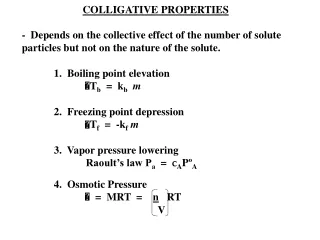
Colligative Properties • depend on number particles in solution NOTtype particles • doesn’t matter what kind of particles (ions or molecules) • concentration of particles doesmatter
What are some colligative properties? • vaporpressure (VP) • decreases (↓) • freezing point (fp) • decreases (↓) • boiling point (bp) • increases (↑) • change in Osmotic Pressure
higher the concentration of solute particles, the greater (larger) the effect on colligative properties
Does it matter if solute is ionic or covalent? YES • number of particles will vary • effected by concentration: • greater concen = greater effect • lower concen = lesser effect
ionic solutes • dissolve in H2O • dissociate into (+) & (-) ions [more particles/moles solute]
MgCl2(s) + H2O(l) Mg2+(aq) + 2Cl(aq) 1 mole salt 3 moles ions (MgCl2) (Mg+2 & 2Cl-1) NaCl(s) + H2O(l) Na+1(aq) + Cl-1(aq) 1 mole salt 2 moles ions (NaCl) (Na+1 & Cl-1)
Covalent solutes dissolve as molecules 1-to-1relationship betweenmoles solute & moles dissolved particles
Covalent substances C6H12O6(s)+ H2O(l) C6H12O6(aq) 1 mole sugar → 1 mole dissolved molecules C6H12O6(s)C6H12O6(aq)
As solute is added to a solvent, what happens to freezing point & boiling point of solution? • The freezing point ↓ & the boiling point ↓ • The freezing point ↓ & the boiling point ↑ • The freezing point ↑ & the boiling point ↓ • The freezing point ↑ & the boiling point ↑ Answer: 2
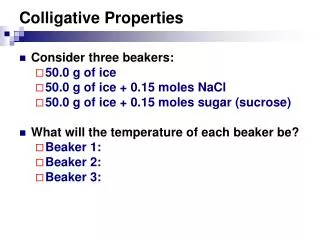
Which solution containing 1 mole of solute dissolved in 1000 g of water has the lowest freezing point? • C2H5OH(aq) • NaCl(aq) • KOH • CaCl2 Be careful! - do you want greatest or least change? What if question asked which solution has highest freezing point? Answer: 4
Of the following solutions, the one that will freeze at the lowest temperature contains 1 mole of nonvolatile solute dissolved in 1) 250 g of solvent 2) 500 g of solvent 3) 750 g of solvent 4) 1000 g of solvent Answer: 1
Which solute, when added to 1000 g of water, will produce a solution with the highest boiling point? 1) 29 g of NaCl 2) 58 g of NaCl 3) 31 g of C2H6O2 4) 62 g of C2H6O2 58g (1 mole) of NaCl → 2 moles of ions 62g (1 mole) of C2H6O2 → 1 mole of molecules
Which solution will freeze at the lowest temperature? 1) 1 g of NaCl dissolved per 100 g of H2O 2) 1 g of NaCl dissolved per 1000 g of H2O • 1 g of C12H22O11 dissolved per 100 g of H2O 4) 1 g of C12H22O11 dissolved per 1000 g of H2O
Which solution will freeze at the lowest temperature? 1) 1 g of NaCl dissolved per 100 g of H2O __1 g____ = 0.017 mol → 0.034 mol of ions 58.8 g/mol (NaCl) (Na+1 and Cl-1) 2) 1 g of C12H22O11 dissolved per 100 g of H2O __1 g___ = 0.0043 mol of molecules 232 g mol
Effect of Non-volatileSolute on Colligative properties: • Boiling Point Elevation (↑) • Freezing Point Depression (↓) • the more particles, the bigger the effect! • the higher the bp and the lower the fp
Applications of colligative properties: 1. salting roads in the winter time ? NaCl or ? CaCl2 2. using salted ice to make ice cream - keeps ice cream from becoming like concrete