Writing Chemical Equations
80 likes | 197 Vues
Chemical equations provide a specific description of the changes occurring during a reaction, detailing reactants (the substances undergoing change) and products (new substances formed). To comply with the law of conservation of mass, balancing equations ensures that the quantity of each type of atom remains the same on both sides of the reaction arrow. For example, in balancing CO2 + LiOH → Li2CO3 + H2O, coefficients are used to equalize the number of atoms involved without altering subscripts. This guide helps in mastering the fundamentals of writing and balancing chemical equations.


Writing Chemical Equations
E N D
Presentation Transcript
Writing Chemical Equations
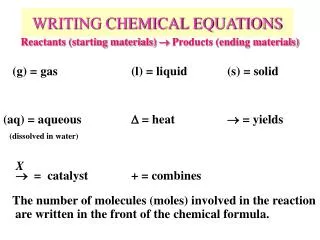
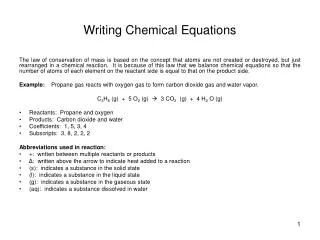
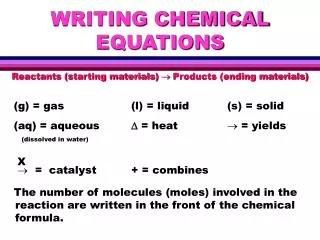
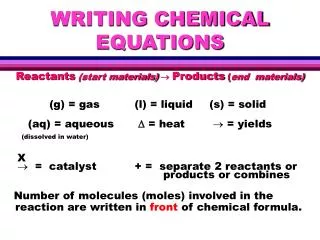
Chemical equations are a specific description of what happens in a reaction Ex. 2H2O 2H2 + O2
2 parts - Chem. equations 1. Reactants (left of arrow) - substances that undergo a reaction 2. Products(right of arrow) - new substances produced
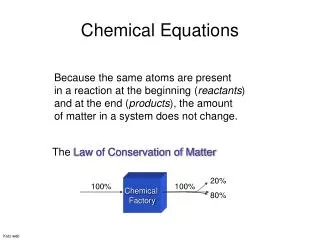
Balancing Chem. Equations • law of conservation of mass must be followed • Mass/matter (atoms) cannot be created or destroyed in a reaction
C -1 C -1 Li - 1 Li - 2 O - 3 O - 4 H - 1 H - 2 Use coefficients - balance # of atoms on each side of arrow Example CO2+ LiOH Li2CO3+ H2O
When trying to balance both sides of the equation Do not change the subscripts
CO2+ LiOH Li2CO3+ H2O 2 Carbon - 1 Carbon - 1 Oxygen - 4 Oxygen - 4 Lithium - 2 Lithium - 2 Hydrogen - 2 Hydrogen - 2 2 is the coefficent