Feasibility of Fluoroscopy-Free Self-Expandable Metallic Stent Insertion for Cervical Strictures
10 likes | 112 Vues
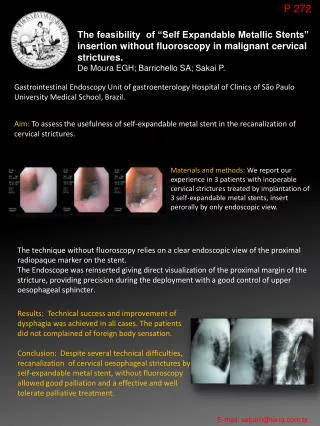
This study evaluates the effectiveness of self-expandable metallic stents in treating malignant cervical strictures without the use of fluoroscopy. In three patients with inoperable strictures, the stents were successfully implanted using only endoscopic visualization of the proximal radiopaque marker. We achieved technical success and significant improvement in dysphagia for all patients, who reported no discomfort from the stents. Our findings suggest that recanalizing cervical strictures without fluoroscopy is a viable palliative treatment option.


Feasibility of Fluoroscopy-Free Self-Expandable Metallic Stent Insertion for Cervical Strictures
E N D
Presentation Transcript
P 272 The feasibility of “Self Expandable Metallic Stents” insertion without fluoroscopy in malignant cervical strictures. De Moura EGH; Barrichello SA; Sakai P. Gastrointestinal Endoscopy Unit of gastroenterology Hospital of Clinics of São Paulo University Medical School, Brazil. Aim: To assess the usefulness of self-expandable metal stent in the recanalization of cervical strictures. Materials and methods: We report our experience in 3 patients with inoperable cervical strictures treated by implantation of 3 self-expandable metal stents, insert perorally by only endoscopic view. The technique without fluoroscopy relies on a clear endoscopic view of the proximal radiopaque marker on the stent. The Endoscope was reinserted giving direct visualization of the proximal margin of the stricture, providing precision during the deployment with a good control of upper oesophageal sphincter. Results: Technical success and improvement of dysphagia was achieved in all cases. The patients did not complained of foreign body sensation. Conclusion: Despite several technical difficulties, recanalization of cervical oesophageal strictures by self-expandable metal stent, without fluoroscopy allowed good palliation and a effective and well tolerate palliative treatment. E-mail: sebarri@terra.com.br







![250-272 Exam Dumps - Actual 250-272 Dumps PDF [2018]](https://cdn4.slideserve.com/7919111/symantec-250-272-exam-symantec-certified-dt.jpg)

![VCS-272 Dumps - [2018] Actual VCS-272 Exam Questiosn PDF](https://cdn4.slideserve.com/8064513/veritas-dt.jpg)