Download
1 / 3
0 likes | 1 Vues
In healthcare, PPK stands for "Patient Participation Knowledge," emphasizing the importance of involving patients in their own care decisions.

E N D
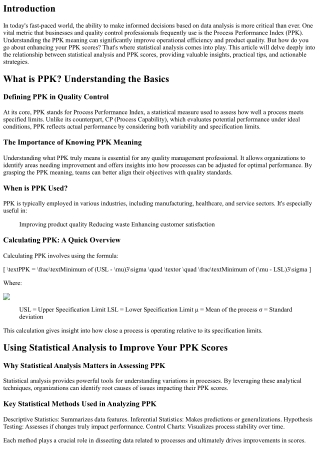
Introduction In today's fast-paced world, the ability to make informed decisions based on data analysis is more critical than ever. One vital metric that businesses and quality control professionals frequently use is the Process Performance Index (PPK). Understanding the PPK meaning can significantly improve operational efficiency and product quality. But how do you go about enhancing your PPK scores? That's where statistical analysis comes into play. This article will delve deeply into the relationship between statistical analysis and PPK scores, providing valuable insights, practical tips, and actionable strategies. What is PPK? Understanding the Basics Defining PPK in Quality Control At its core, PPK stands for Process Performance Index, a statistical measure used to assess how well a process meets specified limits. Unlike its counterpart, CP (Process Capability), which evaluates potential performance under ideal conditions, PPK reflects actual performance by considering both variability and specification limits. The Importance of Knowing PPK Meaning Understanding what PPK truly means is essential for any quality management professional. It allows organizations to identify areas needing improvement and offers insights into how processes can be adjusted for optimal performance. By grasping the PPK meaning, teams can better align their objectives with quality standards. When is PPK Used? PPK is typically employed in various industries, including manufacturing, healthcare, and service sectors. It's especially useful in: Improving product quality Reducing waste Enhancing customer satisfaction Calculating PPK: A Quick Overview Calculating PPK involves using the formula: [ \textPPK = \frac\textMinimum of (USL - \mu)3\sigma \quad \textor \quad \frac\textMinimum of (\mu - LSL)3\sigma ] Where: USL = Upper Specification Limit LSL = Lower Specification Limit μ = Mean of the process σ = Standard deviation This calculation gives insight into how close a process is operating relative to its specification limits. Using Statistical Analysis to Improve Your PPK Scores Why Statistical Analysis Matters in Assessing PPK Statistical analysis provides powerful tools for understanding variations in processes. By leveraging these analytical techniques, organizations can identify root causes of issues impacting their PPK scores. Key Statistical Methods Used in Analyzing PPK Descriptive Statistics: Summarizes data features. Inferential Statistics: Makes predictions or generalizations. Hypothesis Testing: Assesses if changes truly impact performance. Control Charts: Visualizes process stability over time. Each method plays a crucial role in dissecting data related to processes and ultimately drives improvements in scores.
Common Tools for Statistical Analysis Several software tools facilitate statistical analysis: Minitab SAS R Programming Python Libraries (Pandas & NumPy) These tools allow teams to visualize data effectively and derive meaningful insights. Identifying Variability Sources in Processes Types of Variability Impacting PPK Scores Variability can stem from several sources: Common Causes: Inherent fluctuations within a process. Special Causes: External factors impacting consistency unexpectedly. Identifying these sources helps teams take appropriate corrective actions. Utilizing Pareto Charts for Root Cause Analysis A Pareto Chart helps prioritize problems based on their significance: Focus on significant issues first. Use the 80/20 rule to target efforts efficiently. By addressing major contributors first, organizations can see an immediate impact on their PPK scores. Data Collection Techniques for Better Insights Importance of Reliable Data Collection Methods Reliable data collection ensures that statistical analyses yield accurate results. Poor data leads to misleading conclusions about your processes. Methods for Effective Data Collection Surveys and Questionnaires: Gather subjective feedback from stakeholders. Automated Data Logging: Use sensors or software systems for objective measurements. Manual Entry Systems: Implement double-check systems to minimize human error. Each six sigma method has its pros and cons; choosing one depends on your specific context. Analyzing Historical Data Trends The Role of Historical Data in Future Predictions Historical data serves as a baseline against which current performance can be measured. It aids in identifying trends over time—essentially allowing businesses to anticipate future outcomes based on past behaviors. Visualization Techniques for Historical Data Utilizing graphs like line charts or scatter plots helps visualize trends effectively: Highlight upward or downward trends clearly. Identify periods of instability or improvement effortlessly. Making sense of historical data through visuals enhances comprehension among team members who might not be statistically inclined.
Benchmarking Against Industry Standards What is Benchmarking? Benchmarking involves comparing your organization's metrics with industry standards or competitors’ performances to gauge relative success levels. Why Benchmarking Improves Your PPK Scores By understanding where you stand against peers: Gain insights into best practices. Identify gaps in performance. Create actionable plans for improvement based on proven strategies from others who excel at similar tasks. FAQs about Improving Your PPK Scores What does a high PPK score indicate? A high PPK score suggests that a process consistently meets specifications with minimal variation—a sign of effective quality control measures in place. How often should I calculate my organization’s PPK? It's advisable to calculate your organization's PPK regularly—monthly or quarterly—to ensure continuous monitoring and improvements are being made promptly. Can I improve my scores without significant investments? Yes! Many improvements can be achieved through minor adjustments—such as training employees better or optimizing existing workflows—without requiring substantial financial investment upfront. What if my calculations show negative results? Negative results indicate that your https://claude.ai/public/artifacts/27fcc7f1-8f09-45da-848e-56a2af9eb518 process isn't performing adequately against set specifications; this necessitates immediate investigation into root causes followed by implementing corrective actions promptly! Is there software available specifically designed for calculating ppk? Absolutely! Various software solutions like Minitab offer built-in functions specifically designed for calculating metrics such as CPk/PPk along with detailed reporting capabilities making it easier than ever before! Conclusion Improving your Process Performance Index (PPK) scores through statistical analysis isn't just beneficial; it's essential for maintaining competitive advantage across sectors today! By understanding what constitutes good measurement practices while integrating robust analytics techniques like hypothesis testing or control charts—you'll empower yourself with knowledge necessary not only enhance quality but also drive substantial business growth overall! So embark upon this journey armed with insights gained from thorough assessments leading towards achieving excellence within every facet related directly back down towards those all-important numbers we refer too when discussing "using statistical analysis".