
Stratigraphic Insights into Oil and Gas Potential in the Northern Gulf of Mexico Coastal Plain
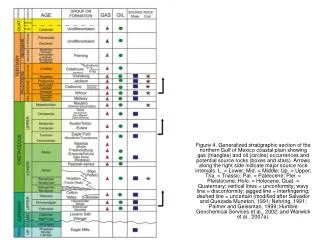
This figure presents a generalized stratigraphic section of the northern Gulf of Mexico coastal plain, highlighting occurrences of gas (triangles) and oil (circles) as well as potential source rocks (boxes and stars). The right side features arrows indicating major source rock intervals across various geological periods, including Triassic, Paleocene, Pleistocene, Holocene, and Quaternary. This analysis provides insights into the relationship between source intervals and second-order transgressions within a sequence-stratigraphic framework, essential for understanding hydrocarbon accumulations in this region.

Stratigraphic Insights into Oil and Gas Potential in the Northern Gulf of Mexico Coastal Plain
E N D
Presentation Transcript
Figure 4. Generalized stratigraphic section of the northern Gulf of Mexico coastal plain showing gas (triangles) and oil (circles) occurrences and potential source rocks (boxes and stars). Arrows along the right side indicate major source rock intervals. L. = Lower; Mid. = Middle; Up. = Upper; Tria. = Triassic; Pal. = Paleocene; Plei. = Pleistocene; Holo. = Holocene; Quat. = Quaternary; vertical lines = unconformity; wavy line = disconformity; jagged line = interfingering; dashed line = uncertain (modified after Salvador and Quezada Muneton, 1991; Nehring, 1991; Palmer and Geissman, 1999; Humble Geochemical Services et al., 2002; and Warwick et al., 2007a).
Figure 3. Stratigraphic column showing the Mesozoic source intervals (arrows) for the offshore Gulf of Mexico. Note that source intervals coincide with second-order transgressions in a sequence-stratigraphic framework (e.g., Haq et al., 1988).