Download
1 / 14
140 likes | 247 Vues
This study explores the utilization of the On-Demand Multicast Routing Protocol (ODMRP) to improve unicast transmission in wireless networks. Traditional multicast protocols struggle with unicast efficiency; however, ODMRP effectively supports both multicast and unicast operations. By implementing concepts such as mesh topology, on-demand route construction, and mobility prediction, ODMRP dynamically maintains connection quality and optimizes routing paths. Performance evaluations reveal that ODMRP, especially when enhanced by mobility prediction, significantly improves packet delivery ratios in varying mobility scenarios.

E N D
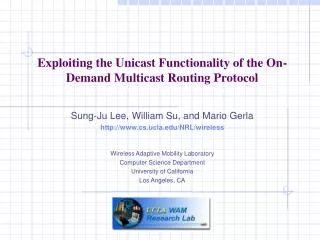
Exploiting the Unicast Functionality of the On-Demand Multicast Routing Protocol Sung-Ju Lee, William Su, and Mario Gerla http://www.cs.ucla.edu/NRL/wireless Wireless Adaptive Mobility Laboratory Computer Science Department University of California Los Angeles, CA
Unicasting using the Multicast protocol? • Generally not possible, or very inefficient • Most of the existing m-cast protocols (eg, AMRoute (Ad-hoc Multicast Routing), CAMP (Core Assisted Mesh Protocol), LAM (Lightweight Adaptive Multicast), etc) run on top of a SEPARATE unicast routing protocol • CAMP and LAM in particular, only work with certain underlying unicast protocol EXCEPTIONS: • Multicast AODV (Ad-hoc On-demand Distance Vector) uses routes obtained from unicast AODV • ODMRP (On-Demand Multicast Routing Protocol) can transparently function as both multicast and unicast
ODMRP Overview • Mesh topology • Forwarding group concept • On-demand route construction • Soft state multicast group maintenance • Unicast capability • Mobility prediction
Forwarding Group FG FG FG FG FG On Demand Multicast Routing Protocol • Forwarding Group: All the nodes inside the “bubble” forward the M-cast packets via “restricted” flooding • Multicast Tree replaced by Multicast “Mesh” Topology • Flooding redundancy helps overcome displacements and fading • FG nodes selected by tracing shortest paths between M-cast members
Route construction in ODMRP • Similar to other on-demand routing protocols • Consists of a query and a reply phase • A source periodically transmits Join Query packets when it has data to send • Join Query packets can carry data payload to eliminate route acquisition latency • Intermediate nodes forward the packet and set up path back to the source (backward learning) • The destination sends a Join Reply in response to a Join Query
Key Differences from Other On-Demand Protocols (e.g., DSR, AODV) • Intermediate nodes can not reply from cache • Data payload piggybacked on Join Queries must reach destinations • Routes replied by destination are more up to date • Query packets are periodically sent as long as there are data packets to send • Fresh routes are continually built and used • Route refresh interval should be carefully selected
Unicast enhancement: Mobility Prediction • Mobility prediction can help determine longevity of routes and schedule refresh requests • Mobility can be predicted, e.g., in an outdoor environment by means of GPS location information; received power based prediction also possible • Join Queries are flooded only before predicted route disconnection time • The scheme adapts refresh interval to mobility patterns and speeds
Route Selection Criteria at Destination • Route 1 is selected if the delay is the criterion • Route 2 is selected if the longevity is the criterion
Performance Evaluation • Simulated in GloMoSim written in PARSEC • Compared the performance of the following schemes: • ODMRP • ODMRP-MP: ODMRP with mobility prediction • WRP (Wireless Routing Protocol): an ad hoc distance vector routing protocol • LAR (Location Aided Routing): an on-demand protocol that uses GPS location information • 50 nodes in 1000 meter X 1000 meter area • Free space propagation model, IEEE 802.11 DCF • Random mobility model • Constant bit rate sources
ODMRP Packet Delivery Ratio as a function of refresh interval
Conclusions • ODMRP is capable of routing both unicast and multicast data effectively • Mobility prediction enhances ODMRP Unicast • Testbed implementation: presented at IEEE ICCCN 2000 • Multicast work: ACM/Baltzer MONET special issue on multipoint communications • http://www.cs.ucla.edu/NRL/wireless
The Number of Total Packets Transmitted per Data Packet Delivered
The Number of Control Bytes Transmitted per Data Byte Delivered by ODMRP with and without Mobility Prediction