Understanding Angles: Measurements, Naming, and Classifications
This guide covers the fundamental concepts related to measuring angles and understanding their components. An angle is formed by two rays with a common endpoint, known as the vertex. Explore different ways to name angles, such as using the vertex or points on each ray, and learn how to measure them in degrees. Understand the types of angles—acute, right, obtuse, and straight—as well as the concept of congruent angles. Lastly, discover the Angle Addition Postulate and apply it to solve angle measurement problems.

Understanding Angles: Measurements, Naming, and Classifications
E N D
Presentation Transcript
Parts of an Angle • An angle is formed by two rays with the same endpoint. • The rays are the sides of the angle and the endpoint is the vertex of the angle. • The interior of an angle is the region containing all points between the sides of the angle. • The exterior of an angle is the region containing all points outside the angle.
Naming an Angle • 3 Ways to name an angle 1. by its vertex (A) 2. by a point on each ray and the vertex (BAC or CAB), 3. by a number (1). *Note: When using 3 points to name an angle, the vertex must go in the middle!
Naming Angles • What are two other names for 1? • What are two other names for KML?
Measuring Angles • One way to measure the size of an angle is in degrees. • To say that the measure of A is 62, you would write mA = 62. Protractor Postulate: Consider OB and point A on one side of OB. Every ray of the form OA can be paired one to one with a real number from 0 to 180.
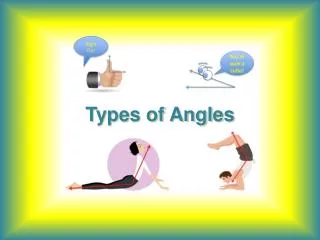
Types of Angles • You can classify angles according to their measures. Symbol for right angle!
Measuring and Classifying Angles • What are the measures of LKN, JKL, and JKN? • Classify each as acute, right, obtuse, or straight.
Congruent Angles • Angles with the same measure are congruent angles. • This means that if mA= mB, then A B (and vice versa). • You can mark angles with arcs to show they are congruent.
Angle Addition Angle Addition Postulate: If point B is in the interior of AOC, then mAOB + mBOC = mAOC.
Using the Angle Addition Postulate • If mRQT = 155, what are mRQS and mTQS?