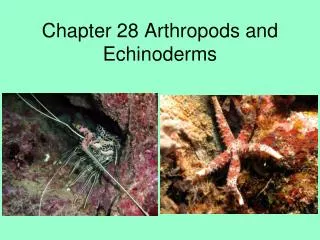
Chapter 28 Arthropods and Echinoderms
Chapter 28 Arthropods and Echinoderms. Introduction to Arthropods. “jointed feet” Most diverse and successful animals Over 750,000 species identified Segmented bodies Tough exoskeleton Jointed appendages. Body Terms. Exoskeleton - external skeleton that protects and supports the body

Chapter 28 Arthropods and Echinoderms
E N D
Presentation Transcript
Introduction to Arthropods • “jointed feet” • Most diverse and successful animals • Over 750,000 species identified • Segmented bodies • Tough exoskeleton • Jointed appendages
Body Terms • Exoskeleton- external skeleton that protects and supports the body • Made of protein and a carbohydrate called chitin • Much variation on exoskeletons • Terrestrial arthropods (Ter. Arth.) have waxy covering to prevent water loss • Appendages- structures like legs and antennae that extend from the body wall
Evolution has led to: • Fewer body segments • The body segments fused together • Highly specialized appendages • For feeding, movement, and more • Legs became: antennae, claws, wings, flippers, tails, mouthparts and walking legs
Form and Function • Feeding • Varied eating habits- herbivores, carnivores, omnivores • Bloodsuckers, filter feeders, detritivores, parasites • Varied mouthparts- pincers, fangs, jaws
Respiration • Tracheal tubes- branching, air filled tubes that are in many ter. arth. • Spiracles- small openings alongside the body that allow air to enter and leave the tracheal tubes • Book lungs- organs with layers of respiratory tissue stacked ex) spiders • Gills- used by aquatic arthropods ex) crabs • Book gills- used by horseshoe crab
Circulation • Open circulatory system- well developed heart pumps blood arteries tissues sinus collects around the heart and re-enters to be pumped through again
Excretion • Malpighian tubules- saclike organs that extract wastes from blood and add them to feces to move through the gut • Used in ter. Arth. • Diffusion- moves cellular waste from the body to the water • Used in aquatic arth.
Response • All have a brain • Well developed nervous system • Two nerves around the esophagus connect brain to the central nervous cord • Connects the ganglia which coordinate movement of legs and wings
Movement • Well developed muscles controlled by nervous system • Individual muscles cells • Muscles generate force (to fly, walk, swim) by contracting a muscle and pulling on the exoskeleton
Reproduction and Molting • Terrestrial • Internal fertilization • Aquatic • Internal and external fertilization • Molting • When an arthropod sheds its entire exoskeleton and makes a larger one in its place • Controlled by the endocrine system with hormones
Subphyla of Arthropods • Crustacea – crabs, shrimp, crayfish • Chelicerata – spiders, ticks, scorpions • Uniramia – millipedes, centipedes • Class Insecta (no subphylum)– 3 part body, 3 pairs of legs
28-4 Echinoderms • “spiny skin” • Endoskeleton- hardened plates of calcium carbonate • Gives bumpy, irregular surface • Only live in the sea • No cephalization • Two sided- oral (with mouth)/aboral
Echinoderm Characteristics • Spiny skin • Internal skeleton • Water vascular system • Suction cup structure called tube feet • 5 part radial symmetry • Larvae- bilaterally symmetrical • Deuterostomes
Water Vascular System • Carries out essential body functions like respiration, circulation and movement • Madreporite- opening to the outside through which water passes • Connects to ring canal which extend out into radial canals along the 5 arms • Tube feet- suction cups on the underside of the body that help with movement and feeding
Feeding • Urchins- scrape algae • Sea lilies- capture floating plankton • Sea cucumbers- take in sand and detritus off sea floor • Sea stars- use tube feet to pull open bivalves, push stomach out, pour enzymes and digest mollusks, brings back stomach into body
Respiration and Circulation • Water vascular system • Thin walled tissues of tube feet for respiration • Skin gills gas exchange
Excretion • Digestive wastes- feces through anus • Ammonia excreted through tube feet
Response and Movement • Don’t have highly developed nervous system • Nerve ring around the mouth • Sensory organs that detect light • Tube feet • Endoskeleton structure/flexible joints
Reproduction • External fertilization • Separate sexes
Groups of Echinoderms • Urchins • Sand dollars • Brittle stars • Sea cucumbers • Sea stars • Sea lilies • Feather stars
Ecology • Urchins control algae • Sea stars control clams and corals • Crown of Thorns • Feeds on corals • Rows of poisonous spines on arms • Great Barrier Reef damage