
Lecture 10: More OLAP - Dimensional modeling
E N D
Presentation Transcript
Lecture 10:More OLAP - Dimensional modeling www.cl.cam.ac.uk/Teaching/current/Databases/
Conceptual Modeling of Data Warehouses Modeling data warehouses: dimensions & measures • Star schema: A fact table in the middle connected to a set of dimension tables • Snowflake schema: A refinement of star schema where some dimensional hierarchy is normalized into a set of smaller dimension tables, forming a shape similar to snowflake • Fact constellations: Multiple fact tables share dimension tables, viewed as a collection of stars, therefore called galaxy schema or fact constellation
Terms • Fact table • Dimension tables • Measures
item time item_key item_name brand type supplier_type time_key day day_of_the_week month quarter year location branch location_key street city province_or_street country branch_key branch_name branch_type Another Star Schema Sales Fact Table time_key item_key branch_key location_key units_sold dollars_sold avg_sales Measures
Dimension Hierarchies sType store city region è snowflake schema è constellations
Cube Fact table view: Multi-dimensional cube: dimensions = 2
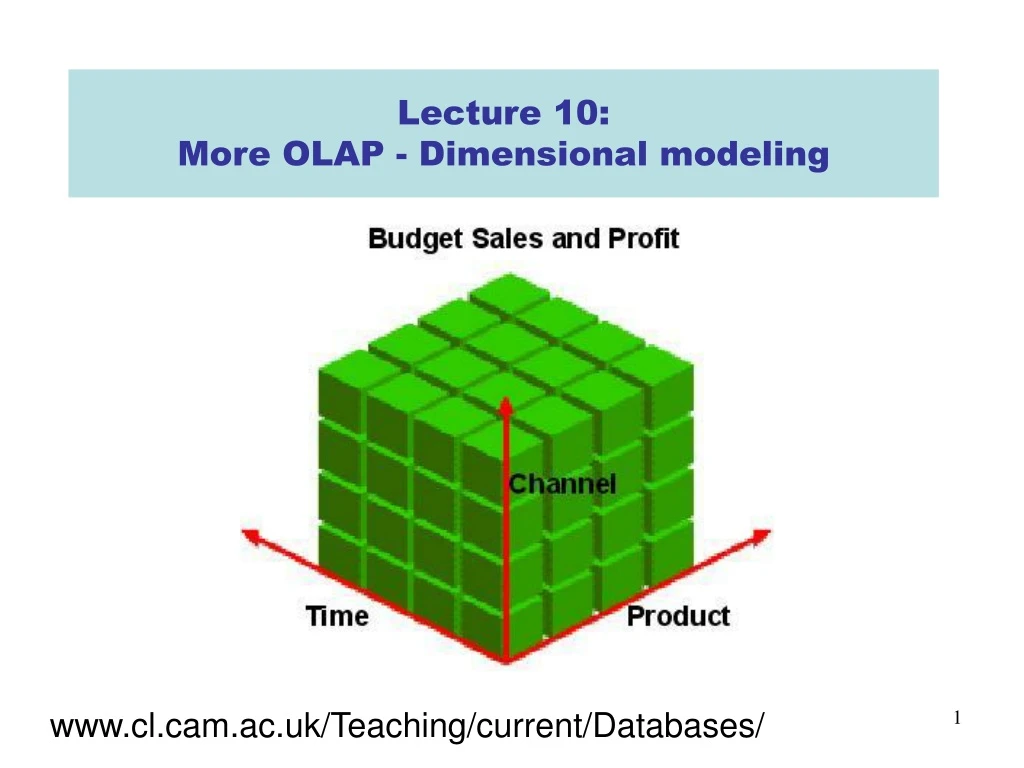
day 2 day 1 3-D Cube Fact table view: Multi-dimensional cube: dimensions = 3
Aggregates • Add up amounts for day 1 • In SQL: SELECT sum(amt) FROM SALE • WHERE date = 1 81
Aggregates • Add up amounts by day • In SQL: SELECT date, sum(amt) FROM SALE • GROUP BY date
Another Example • Add up amounts by day, product • In SQL: SELECT date, sum(amt) FROM SALE • GROUP BY date, prodId rollup drill-down
Aggregates • Operators: sum, count, max, min, median, ave • “Having” clause • Using dimension hierarchy • average by region (within store) • maximum by month (within date)
rollup drill-down Cube Aggregation Example: computing sums day 2 . . . day 1 129
Cube Operators day 2 . . . day 1 sale(c1,*,*) 129 sale(c2,p2,*) sale(*,*,*)
Extended Cube * day 2 sale(*,p2,*) day 1
day 2 day 1 Aggregation Using Hierarchies customer region country (customer c1 in Region A; customers c2, c3 in Region B)
day 2 day 1 Pivoting Fact table view: Multi-dimensional cube: