Understanding State Governments and Their Powers in the U.S. Constitution
This overview outlines the powers granted to state governments by the 10th Amendment of the U.S. Constitution, including key responsibilities such as managing elections, education, law enforcement, public health, and infrastructure maintenance. It explains how states generate revenue through taxes on various commodities and the historical context of state formation following the Revolutionary War. Additionally, it covers the importance of cooperation between states and the federal government, emphasizing shared responsibilities and protections.

Understanding State Governments and Their Powers in the U.S. Constitution
E N D
Presentation Transcript
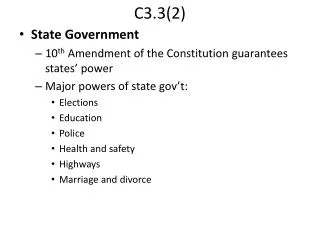
C3.3(2) • State Government • 10th Amendment of the Constitution guarantees states’ power • Major powers of state gov’t: • Elections • Education • Police • Health and safety • Highways • Marriage and divorce
C3.3(2) • How the state pays for the services it provides: • Taxes • Gas • Liquor • Cigarettes • Real estate • Income
C3.3(2) • How the states were formed • 13 Original Colonies became states after the Revolutionary War • Most of the 37 other states were territories • Area governed by the U.S. that is eligible to become a state • Northwest Ordinance (1787) • A territory could apply for statehood once its population reached 60,000 • 37 states have been admitted since the original thirteen • Hawaii was 50th state admitted (1959)
C3.3(2) • U.S. Territories • Puerto Rico • Guam
C3.3(2) • U.S. Territories • American Samoa • U.S. Virgin Islands • Pacific Islands
C3.3(2) • How States Work Together • “Full Faith and Credit Clause” • Article 4 Sec 1 of the U.S. Constitution • Each state will accept the decisions of courts in other states • Extradition • Returning a fugitive back to the state they fled
C3.3(2) • How the Federal Gov’t and States Work Together • Article 4, Sec 4 of U.S. Constitution • Every state must have a republican form of gov’t • People give power to their elected leaders • Elected leaders are responsible for well-being of entire country • Federal gov’t will protect states from invasion • Federal gov’t will protect states from domestic violence • Dangers from within by its own citizens
C3.3(2) • Federal Gov’t and State Gov’t Share Responsibilities • Build highways • I-75: Federal highway • M-28: State highway
C3.3(2) • Federal Gov’t and State Gov’t Share Responsibilities • Assist jobless workers • Help needy citizens • Provide low-cost lunches at school