Revelation vs. Discovery
180 likes | 308 Vues
Every person is inherently a religious being, drawn to the profound questions of existence and the divine. Are we alone? Is there something greater than ourselves? This exploration delves into how we uncover meaning through both natural reason and divine revelation. We can ask and seek answers: Who is God? Why are we here? Through logic, empirical data, and personal experiences, we can arrive at various conclusions about Ultimate Reality, whether through individual discovery or revelation from a higher power. Engage with these age-old mysteries and the roles they play in our lives.


Revelation vs. Discovery
E N D
Presentation Transcript
Big Questions • Every person is a religious being. • A religious being asks the “big questions” • Are we (humans) alone, or is there something greater than us? • Comic books, science fiction, instincts say “Yes” • Is there “another world”? • A world after death? • A world of invisible “souls” or beings? • How did everything begin? • And why? • Who is God? Does he care about us? • Why are we here? What’s the point? • What are some possible answers?
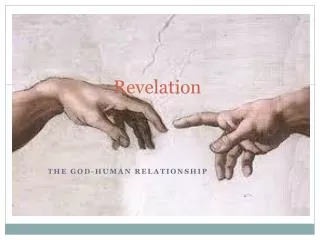
Big Questions • The answer to these questions are a mystery. • These mysteries are solved either by • Natural reason • We try to figure things out on our own using whatever information we can get • Usually relies on empirical data • Divine revelation • What we don’t know and can’t figure out is made clear to us • The hidden is revealed • Both • We use our minds to figure out what God has revealed to us
Discovery • Natural reason can lead on to discover “god” • This discovery of “god” is made on the basis of • Empirical data • Looking at the world • Reflections on human psychology, human instincts and innate knowledge • Logical Reasoning (natural reason) • Natural reason, if rigorously followed, opposes • Animism and pantheism • Atheism • Agnosticism
Discovery • Natural reason, if logically followed, reaches these conclusions: • There is an “Ultimate Being” or “Ultimate Reality” • The “Ultimate Being” is one, not several • Discovery may also conclude that • The “Ultimate Reality” is person (not “I) – monotheism • The “Ultimate Reality” is personal but detached and uncaring – Deism • The “Ultimate Reality” is a force or flow – theism
Discovery • Discovery also leads to the conclusion that • Humans are “god” • Humans need to escape the material word to be “god” • When humans are “perfected” or “enlightened” they become “god” • True enlightenment is when a human loses himself in “god” • Like a drop of water in an ocean • Discovery reaches these conclusions from “the bottom up” • By mystical experience (looking inward, reflecting, meditating) • By logical reasoning (thinking)
Discovery • Discovery, using natural reason, is the method used by the major Eastern religions • Hinduism • Buddhism • Daoism
Revelation • Revelation admits that we can’t know what we can’t know • We learn partly by discovery, but mostly by being told • Example: We discover the round bouncy object, but someone must tell us that it is a ball • Example: We discover simple arithmetic (quantity, addition, subtraction, multiplication, division), but we must be told about mathematics • Example: We discover our own selves, but must be told who are parents are and how we came to be • Revelation requires two things: • Being told what we don’t know and can’t figure out • Believing what we’re told
Revelation • The JoHari window helps us understand the importance of revelation
Revelation • Revelation of God works from “the top down” • God tells us about Himself • God tells us how things came to be • God tells us about ourselves • What we’re really like inside • Why we do what we do • The point of our existence • God tells us the goal
Revelation • God must reveal Himself • Directly • Speaking directly to humans • Indirectly • Speaking through mediators • Specific humans (prophets) • Oral tradition (stories handed down) • Through events • Miracles • Omens • History (sacred history) • Sacraments
Revelation • Revelation concludes that • There is one God • God is the cause of all things • God is a personal being (an “I”) • We are not God • We are separate beings from God • There is a “visible” world and an “invisible” world • Material dualism • The goal of life is to be in relationship with God
Revelation • Revelation is what three major religions depend upon • Judaism • Christianity • Islam
God Reveals Himself The Christian Understand of Revelation
Word • God Reveals Himself through His Word • Logos • Torah • Pen-ultimately, the Scriptures • Old Testament: the curtain slowly pulls back • New Testament: the play is plainly shown • Ultimately, Jesus
Scriptures: Old Testament • God reveals Himself in Myth • Fiction or non-fiction stories that explain origins • Origin of all things (Gen 1) • Origin of humans (Gen 2) • Origin of sin (Gen 3) • Origin of death (Gen 4-5) • Origin of second changes; the reboot (Gen 6-10) • Origin of languages (Gen 11) • God reveals Himself in Sacred History • History is told or arranged to point to God • Not made up, but told with God in mind
Scriptures: Old Testament • God reveals Himself in types • Hints left, on purpose, to point ahead • Genesis 22 • God reveals Himself in Covenants • Adam (Gen 3.15) • Noah (Gen 9) • Abraham (Gen 22) • Moses & Israel (Ex 19 & 20) • David (2 Sam 7)