Constitutive Relations
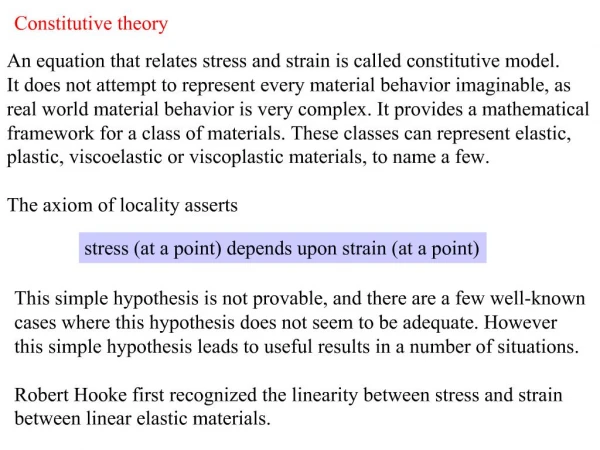
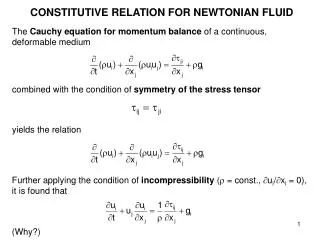
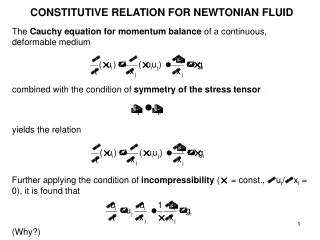
Constitutive relations are essential in chemical engineering, linking conserved extensive quantities to intensive variables. They define the behavior of physico-chemical properties such as enthalpies, densities, and viscosities, and play a crucial role in transfer rates of mass and energy. These relations stem from conservation equations for mass, energy, and momentum, and involve both convective and molecular flow terms. By establishing transaction relations, reaction rates, and thermodynamic relations, constitutive relations help model complex systems, such as Continuous Stirred-Tank Reactors (CSTR), while considering factors like control systems, sensors, and valves.

Constitutive Relations
E N D
Presentation Transcript
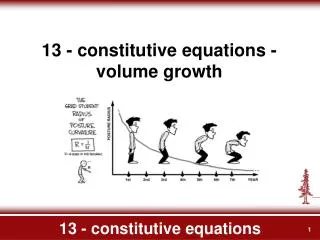
What are constitutive relations? • Relate conserved extensive quantities to intensive variables • Help define physico-chemical quantities (e.g. enthalpies, densities, viscosities ,…) • Define transfer rates (mass, energy, …) • Other relations to “constitute” the model
How do constitutive relations arise ? • Related to the terms in the conservation equations for mass, energy and momentum • Convective flow terms (process streams) • Molecular flow streams (fluxes) • Internal processes • Defining intensive variables in terms of extensive quantities and other physico-chemical properties • Constraints on the system (control relations)
CSTR Example A B Constant V
Transfer relations Reaction rates Constitutive Property definitions Equations Balance volume relations Equipment and control constraints Classes of Relations
1. Transfer Relations • General form • Particular forms • mass transfer • heat transfer
CSTR Example - Qloss Qloss = UA(T-Tamb) A B Qloss
2. Reaction rates • Reaction rate (batch reactor only) • General reaction expression
CSTR Example A B
3. Thermodynamic relations • Property relations (density, viscosity, …) • Equilibrium relations • Raoult’s law • Relative volatility, K-value • Activity coefficient
CSTR Example A B
Thermodynamic properties • Enthalpy • linear • nonlinear
CSTR Example A B
Thermodynamic properties • Equations of state • ideal gas • cubic EoS • Soave Redlich Kwong • Peng Robinson • NRTL
4. Balance volume relations • Relations between phases VG VL
5a. Sensors • Sensors
5b. Transmitters • Transmitters (4-20mA, 20-100kPa)
5c. Controllers • Traditional (P, PI, PID)
5e. Valves • Static valves • Control valves • characteristics