
Multiple Stressors
E N D
Presentation Transcript
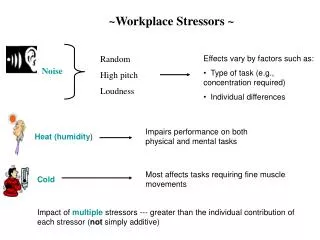
Multiple Stressors • Nutrient loading (nitrogen, phosphorous) or eutrophication • UV light (UVB) • Contaminants (toxins, sediments) • Global warming (increased SST) • Atmospheric CO2 (plant growth) • Hypoxia, anoxia (dead zones) • Introduced species • Many more…
Multiple Stressors • Attempts to measure impacts of multiple stressors are fairly recent • Only a limited number of habitats or species have been the subject of studies of multiple stressors • Information usually incomplete and address pairs or small number of risks • Many studies on temperature, contaminants, and nutrients, others less well studied • Impacts on populations or habitats of most conservation interest poorly represented
Rocky Shores • A few studies on temperate rocky shores have looked at multiple stressors • One conducted in Australia (Przeslawski et al. 2005) looked at the effects of UV radiation together with temperature and salinity stress • They found significant effects of UV (12 fold higher mortality) • Effects of salinity in the presence of UV were much more negative
Antarctic Habitats • Lenihan et al. (2003) conducted multiple stressor experiments on Antarctic benthos • They used total organic carbon and copper as stressors in field experiments • They found interacting effects which varied by taxa • Annelids increased with TOC across Cu treatments • Arthropods and echinoderms decreased with Cu but responded variably to TOC depending on feeding mode
Coral Reefs • Nordemar et al. (2003) exposed corals (Porites) to nutrient and temperature stresses • They exposed corals in mesocosms to combinations of nitrogen additions and temperature increases • They found changes in gross productivity although specific effects on the zooxanthellae were less
Coral Reefs • Bruno et al. (2003) looked at nutrient addition and the outbreak of yellow band disease of corals in Mexico • They added nutrients (nitrogen) in the field and monitored the progression of yellow band disease • The found strong effects of nutrients on tissue loss and disease
Coral Reefs • Dunn and Brown (2001) followed coral bleaching in Thailand • They compared severity of bleaching with temperature and UV records (together with sea surface) • They found that bleaching occurred not just in response to temperature but much more strongly following exposure to solar radiation
Coral Reefs • Porter et al. 1999 looked at temperature and salinity stress in FL corals • They found significant interactions and magnification of temperature stress at higher salinities
Algal Responses • Hoffman et al. (2003) conducted experiments to look at temperature and UV in algae • They used Fucus in the northwest and subjected this experimentally to UV and temperature at the same time • First studies to experimentally manipulate temperature and UV in a multicellular organism • They found very large difference among taxa and a strong interaction among stressors
Estuarine Stressors • Estuaries are among the places where multiple stressors have best been studied • Many studies of effects of contaminants, but fewer looking at other stressors (salinity, temperature, nutrients)
Estuarine Stressors • Good examples from Chesapeake Bay, MD (many labs, many scientists) • Experiment (Breitburg et al. 1999) looked at nutrients and trace metals on many aspects of Chesapeake food webs • 20 L mesocosms were constructed • Nitrogen and phosphorous (nutrients) • A mixture of arsenic, cadmium, copper, nickel and zinc (trace elements) • They found consistent effects of nutrients (higher in most cases) but trace elements had variable and ofter negative effects • These negative effects were also increased by nutrient additions (reversing nutrient effect)