Understanding Soils: Their Importance, Evaluation, and Erosion Effects
This presentation discusses the essential role of soils in providing fundamental life needs such as food and shelter. It focuses on key concepts in land evaluation: soil texture, depth, slope, and erosion. Knowing soil texture helps determine properties affecting plant growth, while depth indicates the viability of root zones. The slope impacts agricultural suitability, and understanding erosion is crucial for conservation. Techniques for measuring these factors are outlined for effective land management, preventing soil loss, and maintaining soil health.

Understanding Soils: Their Importance, Evaluation, and Erosion Effects
E N D
Presentation Transcript
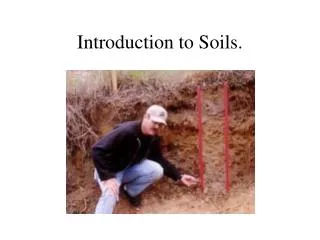
Introduction To Soils Original Power Point Created by Darrin Holle Modified by Georgia Agricultural Education Curriculum Office June 2002
Soil and It’s Importance • Provides basic life needs • Food and Shelter • Very limited resource
Main Ideas in Land Evaluation • 1. Texture • 2. Depth • 3. Slope • 4. Erosion
1. Texture • Affects almost all properties of the soil • The amount of sand, silt and clay in a soil • Sand=largest, then silt, then clay • Determine by ribboning the soil
1. Texture • Sand is looser and gritty • Silt feels floury • Clay is sticky
1. How to determine Texture • COURSE=NO BALL • MODERATLY COURSE= 1” and gritty • MEDIUM = 1” and smooth • MODERATELY FINE = 1-2” • FINE = 2”
Depth • Total thickness of material available for plant growth • Plants obtain water, nutrients and support from the root zone • Total Depth is determined from the point where the roots stop
Depth • DEEP=40” • MODERATLEY DEEP = 20-40” • SHALLOW = 10-20” • VERY SHALLOW = -10”
Slope • Slope refers to the steepness of the land surface • Affects soil use and management • As slope increases agriculture suitability decreases
How to measure Slope • Measured in percent • Rise or fall over 100 feet
How to measure Slope • NEARLY LEVEL = 0-1% • GENTLY SLOPING = 1-3% • MODERATELY SLOPING = 3-5% • STRONGLY SLOPING = 5-8% • STEEP = 8-15% • VERY STEEP = +15%
Erosion • Causes loss of soil by water and wind • If one knows history of land can then do something to prevent more losses
Erosion Calculation • One will be given original topsoil • To find current topsoil drag knife through top layer until it stops. This is the topsoil
Erosion Calculation • Divide the current topsoil by the original to give you what percent is left • Then subtract that from 100% and that gives you amount of erosion.
Erosion Levels • NONE TO SLIGHT = 0-25% • MODERATE = 25-75% • SEVERE = 75%+ with crossable gullies • VERY SEVERE = 75%+ with uncrossable gullies