Impact of Divalent Cations on HIV Reverse Transcriptase Extension Rate Using Unstructured Templates
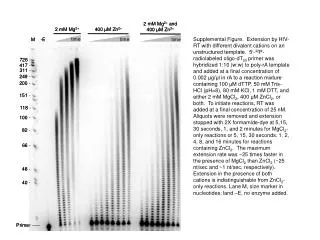
This study investigates the extension rates of HIV reverse transcriptase (HIV-RT) in the presence of different divalent cations—specifically magnesium chloride (MgCl2) and zinc chloride (ZnCl2)—using a poly-rA template with a radiolabeled oligo-dT20 primer. The reactions were monitored over various time points, highlighting that the maximum extension rate reached approximately 25 nucleotides per second in the presence of MgCl2, significantly faster than the ~1 nucleotide per second rate observed with ZnCl2. The combined presence of both cations produced indistinguishable results from ZnCl2 alone.

Impact of Divalent Cations on HIV Reverse Transcriptase Extension Rate Using Unstructured Templates
E N D
Presentation Transcript
Supplemental Figure. Extension by HIV-RT with different divalent cations on an unstructured template. 5‘-32P-radiolabeled oligo-dT20 primer was hybridized 1:10 (w:w) to poly-rA template and added at a final concentration of 0.002 μg/μl in rA to a reaction mixture containing 100 μM dTTP, 50 mM Tris-HCl (pH=8), 80 mM KCl, 1 mM DTT, and either 2 mM MgCl2, 400 μM ZnCl2, or both. To initiate reactions, RT was added at a final concentration of 25 nM. Aliquots were removed and extension stopped with 2X formamide-dye at 5,15, 30 seconds, 1, and 2 minutes for MgCl2-only reactions or 5, 15, 30 seconds, 1, 2, 4, 8, and 16 minutes for reactions containing ZnCl2. The maximum extension rate was ~25 times faster in the presence of MgCl2 than ZnCl2 (~25 nt/sec and ~1 nt/sec, respectively). Extension in the presence of both cations is indistinguishable from ZnCl2-only reactions. Lane M, size marker in nucleotides; land –E, no enzyme added.