Network File System Protocol
The Network File System (NFS) allows transparent remote access to shared files across networks, enabling interconnectivity between different architectures and operating systems. Developed by Sun Microsystems, NFS has evolved through several versions, starting with version 1 in 1984, with notable advancements in versions 2, 3, and 4 defined in RFCs. The file system organizes data using inodes and employs remote procedure calls (RPC) for efficient file handling, emphasizing statelessness for improved performance and reliability. This overview highlights the key features and purposes of NFS in modern computing.

Network File System Protocol
E N D
Presentation Transcript
Network File System Protocol By Authentication Experts
Introduction • Provides transparent remote access to shared file across the network • Portable across different architecture and operating system
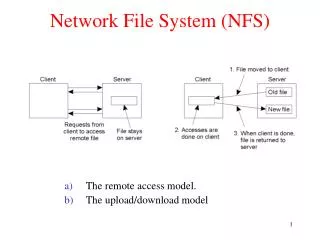
Introduction • Aim: to provide the following logical view
Introduction • First version developed by Sun Microsystems for internal research • Version 2 introduced in March, 1989 defined in RFC 1094 • Version 3 introduced in June, 1995 defined in RFC 1813 • Version 4 introduced in December, 2000 defined in RFC 3031; revised in RFC 3530, April 2003
Introduction to File System • A file system is a way of storing data on a medium: the way it is organized and managed • Every file is represented by an “inode” A file descriptor holding, among other things, file access permissions, physical block addresses holding data, etc. • The NFS server’s task is to give clients the inodes they want to access • An NFS server gives an additional net layer allowing remote machines to handle the inodes
The NFS Protocol NFS is built from 4 distinct protocols: • nfs - File creation, searching, reading, writing Authentication and statistics • mountd - Mounting of “exported” systems for access via nfs • nsm - Network Status Monitor - Monitors a client or server machine’s status • nlm - Network Lock Manager - Avoid simultaneous data modification by multiple clients
File Handling in NFS • The protocol revolves around the filehandle -A data structure allow unique identification of a file system object -Contains the file inode and an entry representing the device where the file resides • How does a server know which file/directory the client needs to access? - At first, client obtains a file handle for root of the file system - File handle is opaque to the client - Client sends file handle to server when referencing a file/directory - No need to use the full path names • The file handle contains whatever information the server needs to distinguish an individual file
The NFS Protocol • Each relies on Remote Procedure Calls(RPC) andPortmap(also calledrpc.portmap). • An RPC server tells portmap which port will be used and the managed RPC number • A client contacts portmap to get port number of desired server program • RPC packets are addressed to the corresponding port
Statelessness • What is statelessness ? - Server does not need to maintain protocol state about it’s client - Server does not keep previous request information - Client keeps track of all information required to send requests to the server • Advantage : - If server crashes, no state information lost - Client needs only retransmit a request until the server responds
NFS Version 3 • Introduced in June,1995, described in RFC 1813 • Support for 64-bit file sizes and offsets, to handle files larger than 4 GB • Support for asynchronous writes on the server, to improve write performance • Using TCP as a transport made using NFS over a WAN more feasible
NFS Version 4 • Introduced in December,2000(RFC 3010) and revised in April,2003, described in RFC 3530 • Introduces a stateful protocol • Mandates strong security • Performance improvements