
Investigating Short GRBs: Are They Magnetar Flares from Nearby Galaxies?
E N D
Presentation Transcript
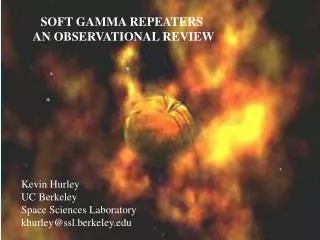
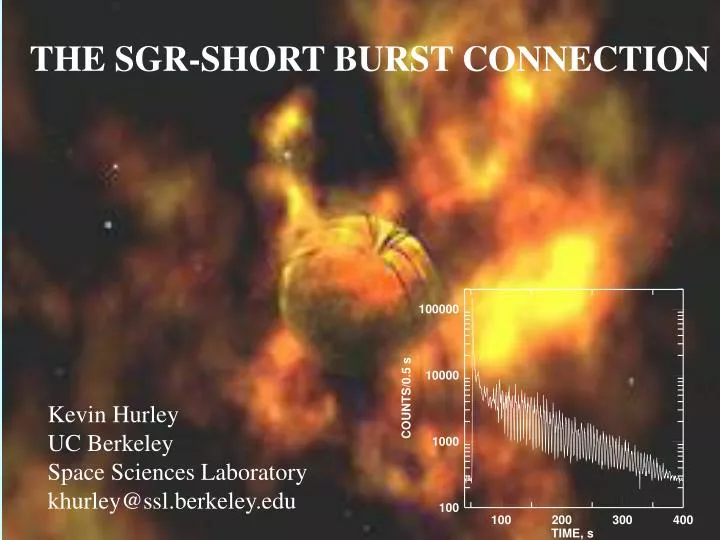
THE SGR-SHORT BURST CONNECTION SOFT GAMMA REPEATERS Kevin Hurley UC Berkeley Space Sciences Laboratory Kevin Hurley UC Berkeley Space Sciences Laboratory khurley@ssl.berkeley.edu
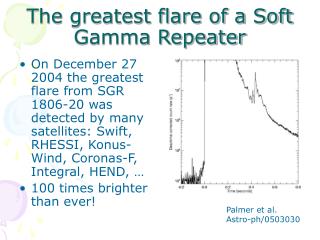
ARE SOME SHORT GRBs ACTUALLY MAGNETAR FLARES IN NEARBY GALAXIES? • SGR giant flares begin with a ~0.2 s long, hard spectrum spike • The spike is followed by a pulsating tail, but it only contains ~1/1000th of the energy • Viewed from a large distance, only the initial spike would be visible • It would resemble a short duration, hard spectrum GRB • It could be detected out to ~100 Mpc GIANT FLARE FROM SGR1806-20 RHESSI DATA
Some short GRBs are almost certainly giant magnetar flares, but how many? • The answer depends on giant magnetar flare luminosities and rates (their number-intensity distribution), which are poorly known • Two approaches: statistical, and burst-by-burst
HOW MANY ARE THERE?(STATISTICAL. I) • Lazzati et al. (2005) studied BATSE short bursts with blackbody-like energy spectra • They found only 3 • Their conclusions: • Up to 4% of short bursts could be SGR giant flares (2σ limit), or • We have overestimated the energy of the galactic giant flares, or • We have overestimated the rate of galactic giant flares
HOW MANY ARE THERE?(STATISTICAL. II) • Nakar et al. (2006) searched for nearby galaxies in the error boxes of 6 short duration hard spectrum GRBs • Their conclusions: • <15% of BATSE short/hard GRBs are SGR giant flares, or • SGR giant flares can be much more energetic and more distant, or • SGR giant flares are very rare, possibly once in a magnetar lifetime, or • The distance to SGR1806 is smaller than previously thought
HOW MANY ARE THERE?(STATISTICAL. III) • Popov & Stern (2005) looked for BATSE bursts from four nearby (<3.7 Mpc) galaxies undergoing star formation, and from the Virgo cluster (17 Mpc) • Their conclusions • < a few percent of BATSE bursts are giant flares, and giant flares are very rare (1/1000 years/magnetar), or • Distance to SGR1806-20 has been overestimated
GRB051103 – A POSSIBLE EXTRAGALACTIC GIANT MAGNETAR FLARE FROM M81 (3.6 Mpc) M82 M81 Swift BAT 15-150 keV (Not imaged) IPN Error Ellipse Eγ=7x1046 erg Frederiks et al. 2007
GRB070201 – A POSSIBLE EXTRAGALACTIC MAGNETAR FLARE FROM M31 (780 kpc) Mazets et al. 2008 IPN Error Box M31 LIGO measurements indicate that this could not have been a binary merger in M31 (Abbott et al. 2008) Eγ=1.5x1045 erg
GRB050906 – A POSSIBLE SGR GIANT FLARE FROM IC 328 (130 Mpc) • GRB050906 was a 0.26 s long, very weak (6x10⁻⁹ erg cm-2) Swift burst • It had no fading X-ray or optical counterpart • The BAT error circle includes a z=0.43 cluster (130 Mpc), with a starburst galaxy, IC 328 • If this was its origin, Eγ~1.5x1046 erg Levan et al. 2008
NUMBER-INTENSITY RELATION FOR 6 SGR GIANT FLARES* *not to be taken too seriously
CONCLUSIONS • A small percentage of short GRBs are extragalactic giant magnetar flares • Their number is small enough that it does not contradict anything we know about short GRBs • But it is not zero, so it is important to understand them from the SGR point of view • A definitive search through existing data has not been carried out yet