Download
1 / 13
130 likes | 258 Vues
This document explores the concept of data warehousing as outlined by industry leaders Bill Inmon and Ralph Kimball, examining the differences between data warehouses and data marts. It discusses key attributes such as architecture, granularity, and deployment strategies, highlighting the advantages and criticisms of each approach. The text emphasizes how data marts can be tailored to meet specific business unit needs while acknowledging the complexity of integrating multiple marts. Conclusions reveal that while data marts are valuable, a robust data warehouse architecture remains essential for comprehensive data management.

E N D
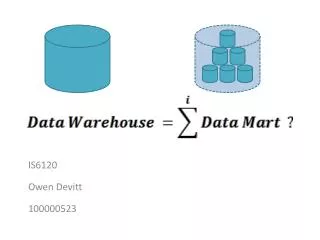
IS6120 Owen Devitt 100000523
Data Warehouse (Corporate Information Factory) “You can catch all the minnows in the ocean and stack them together and they still do not make a whale.” • Bill Inmon Data Mart (Data Warehouse Bus) “… The data warehouse is nothing more than the union of all the data marts …” • Ralph Kimball
Two Types of Data Mart • Dependent Marts • Independent Marts Legacy Systems
Data Warehouse • Top-Down approach • Holds multiple subject data • Services the needs of all users – owned by corporation • Low-level granularity • Normalized • Useful for data mining – discovering previously unknown connections
Data Warehouse • Criticism • Kimball and other data mart vendors suggest that DWs are large, long-term projects and that value is produced only after a number of years • Inmon refutes this claim (Inmon, 1999) • Expensive to maintain • Slow deployment
Data Warehouse Development • Iterative development
Data Mart • Bottom-up approach • Owned by a department • Services the needs of specific business units/departments • Star-join structure • Technology optimal for access and analysis • Rapid Deployment • “…departments and divisions are going to create their own mini data warehouses to answer urgent business questions…” (Kimball, 1998)
Data Mart • Criticism • Inmon suggests that data mart granularity is not as low-level as data warehouse granularity • Kimball refutes this claim (Kimball, 1998) • Large amounts of redundancy • High-level granularity (according to Inmon) • Synchronicity an issue • Large numbers of data marts become as difficult as legacy systems to integrate
Data Mart Development • Independent development
Similarities • Both use a staging area • Data Warehouse (DW view) • Backroom (DM view) • Both extract from a single source once • Both claim to be based on the most atomic data available from the source
Key Differences Data Warehouse • Hard work is done at the beginning • Dependent Data Marts – sourced from the DW • Iterative development Data Mart • Hard work is done on integration • Independent Data Marts – sourced from the legacy systems • Independent development
Conclusion • A Data Warehouse may be equal to the sum of its dependent Data Marts • Data Marts are useful for organizations that do not intend to utilize a corporate-wide data warehouse • Data Warehouse architecture is more robust and scalable than Data Mart architecture • Only the strictest, most forward-thinking data mart development can be equivalent to a data warehouse