Download
1 / 20
210 likes | 341 Vues
This study guide delves into the key characteristics of populations, including geographic distribution, density, and growth. It explores examples of populations, the impact of resource availability, and how changes at one level affect food webs. There’s a focus on growth factors such as immigration, births, and shrinking factors like emigration and deaths. The guide also discusses the difference between exponential and logistic growth, highlighting situations where populations grow rapidly due to abundant resources.

E N D
What is a Population All the members of the same species living in the same place at the same time. • Which of the following would be an example of a population? • A. All the palm trees and bushes on an island. • B. All the humans at a high school basketball game. • C. All the different groups of fish and algae in a lake. • D. None of the above
Characteristics of a Population • Geographic Distribution – • area in which population lives • Population Density – • number of individuals in an area • Growth – • the amount by which the population size changes in a given time period.
Characteristics of a Population • Which of the following is one of the main characteristics used to describe a population? A. number of individuals B. color of individuals C. number of species D. kind of adaptations
Which of the following correctly shows the levels of organization from smallest to largest? • A. organism, population, community, ecosystem, biome, biosphere • B. organism, community, biome, ecosystem, population, biosphere • C. biosphere, biome, ecosystem, community, population, organism • D. biosphere, population, biome, community, ecosystem, organism
The levels of the Biosphere • Biosphere levels from largest to smallest • BIOSPHERE • BIOME • ECOSYSTEM • COMMUNITY • POPULATION • ORGANISM
Population Affects Food Webs • If the population of producers decrease, then the population of primary consumers will decrease if they don’t have enough food.
Populations and Food Webs • If the population of primary consumers decrease: • Then the producer population increases because there are less consumers eating them. • The secondary consumer population decreases because there is less food for them.
What will Happen to food webs if a population changes? • If a population of organisms of any level in a food web changes it will: • A. Have no affect at other levels • B. Only affect the population that changes • C. Affect populations at the other levels • D. None of the above.
Which organism will be most affected in the food web if the rabbit population decreases? • A. MOUSE • B. SNAKE • C. JACKAL • D. LION
Populations are affected by many resources: • These are: • The amount of available food in an area. • The amount of sunlight (if a plant) • The amount of water • The competition for food/shelter • The predators in an area
As resources in a population start to decrease, the population growth will: • A. declines rapidly. • B. increases slowly. • C. reaches carrying capacity. • D. enters a phase of exponential growth.
Changes in Population Size • Growth factors • Immigration: individuals moving into a population • Births • Shrinking factors • Emigration: individuals moving out of a population • Deaths
Which are two ways a population can decrease in size? • A. immigration and emigration • B. increased death rate and immigration • C. decreased birthrate and emigration • D. emigration and increased birthrate
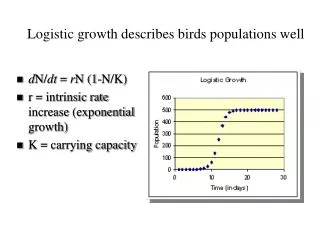
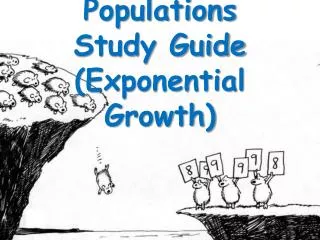
Unlimited Growth • If there are no limiting resources, populations grow exponentially. • Birth Rate > Death Rate
Which of the following graphs shows a population with unlimited resources? • B. • A. • C. • D.
Exponential Growth • Early phase of growth • High availability of resources • Little competition • Little predation
When individuals in a population reproduce at a constant rate, it is called? • A. logistic growth. • B. growth density. • C. exponential growth. • D.multiple growth.
Which statement below best describes the population shown in the graph? • A. There are more births than deaths. • B. There are less births than deaths • C. Births and Deaths are equal • D. The birth rate equals ZERO.
Human Population Growth Are humans in exponential or logistic growth?