Solving Equations and Circular Motion
180 likes | 323 Vues
This document explores the concepts of solving equations related to motion in physics, particularly in circular motion and projectile motion. Key equations such as velocity (v=∆x/∆t), acceleration (a=∆v/∆t), and position (∫v dt = position) are derived and explained. We address common word problems including thrown objects and their maximum heights, using formulas to find time and displacement. Additionally, we introduce the relationships in uniform circular motion and present vector representation in Cartesian and polar coordinates, fostering a comprehensive understanding of these fundamental physics principles.


Solving Equations and Circular Motion
E N D
Presentation Transcript
Solving Equations and Circular Motion Physics 2211
Solving Equations • Algebraic • v = ∆x/∆t • a = ∆v/∆t • Cartesian
Area ∫vdt = position Word Problems V t
Deriving the Equation • a = c most common case • v = ∫ adt = gt∫ + k = g(t2 – t1) + k • If t1 = 0 • gt] + k = gt +k • v = gt +v0 • v = ma +b t2 t2 t1 t1 t 0 m = a (x, k )
Finding x from v=gt + v0 t2 x = ∫ vdt = ∫ (gt + v0)dt = ∫ gtdt + ∫ v0dt = (1/2)gt2 +k + v0∫ dt = (1/2)gt2 + k1 + v0t + k2 = (1/2)gt2 + v0t + k3 k3 = x0 xf = (1/2)gt2 + v0t + x0 t1 t 0 t t 0 0 t 0
Formulas xf= (1/2)gt2 + v0t + xi xf=at + v0 xf = xi + (1/2)(vi + vf)t missing a vf = vi2 + 2a(xf – xi) missing t
Example 1 A man throws a ball straight up with the following specifications: vi = 20m/s, a = -10m/s2, xi = 50m At what time does the ball reach its highest point? What is the highest point? When does the ball reach 60m?
Getting Started Use equation xf= (1/2)gt2 + v0t + xi Negative Parabola when slope = 0, (dx/dt) = 0 Slope = 0 - - + + x
Finding t (dx/dt) xf = (dx/dt) [(1/2)(at2) + vit + xi] 0 = at + vi at = - vi t = -vi/a
Finding ball’s highest height -20(m/s) / -10(m/s2) = 2s Therefore, the ball is at its highest when t = 2s Xh = -5(m/s2) *4s + 20(m/s)*2s + 50m = -20m + 4m + 50m = 70m Therefore, the ball’s highest point is at 70m.
Finding the ball at 60m 0 = (1/2)at2 + vit + (xf – xi) 0 = at2 + bt + c t = (2±√2)s ***More than 1 answer!! There is only 1 answer at the top, everywhere else there are 2 roots
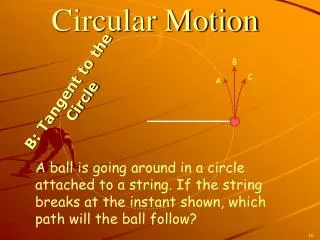
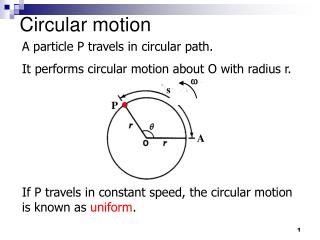
Uniform Circular Motion A marker is placed on an old record player. On top, it goes all the way around; from the side it looks like it is going side to side.
Circular Motion Points on a circle are described as: x = cos (wt) y = sin (wt) w speed of rotation *Remember: cos starts at 1, sin starts at 0
Therefore v = (d/dt) cos (wt) = -w sin(wt) a = (dv/dt) = -w2cos(wt) = -wx a is oppositely proportional to position Harmonic motion - sin in circular motion velocities and accelerations that vary
Vectors Cartesian unit vectors v = RcosθÎ + RsinθĴ = R (cosθÎ + sinθĴ) Polar Angles can be useful x = Rcosθ y = Rsinθ