Download
1 / 30
300 likes | 388 Vues
Explore the rapid transition and reintensification of hurricanes Danielle and Earl using the MC2 model. Learn about the crucial role of upstream troughs, remnant vortices, and downstream features in extratropical transitioning. Discover the sensitivity of extratropical transitions to various atmospheric dynamics and thermodynamics aspects.

E N D
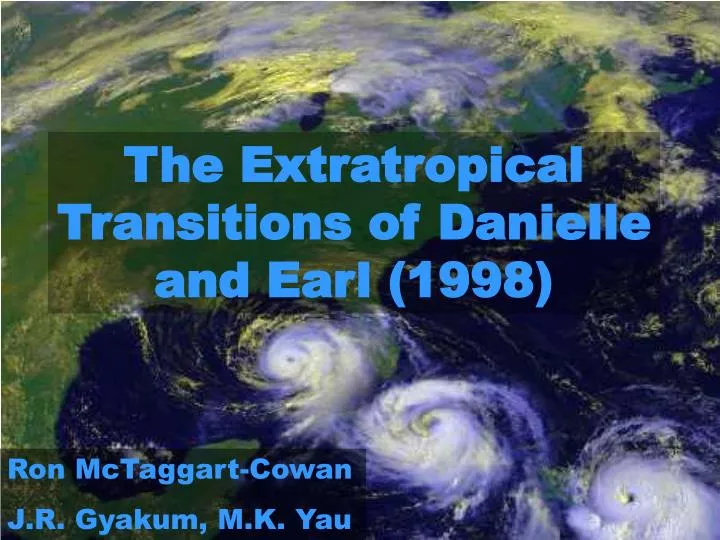
The Extratropical Transitions of Danielle and Earl (1998) Ron McTaggart-Cowan J.R. Gyakum, M.K. Yau
Outline • Motivation and ET background • Case description • Important upstream features • Important downstream features • PVmc introduction • Importance of remnant vortex • Discussion
ET Background • 50% of Atlantic hurricanes ET • The resulting storm is often more intense than the hurricane • ETs are very hard to forecast in real time
Case Description • Danielle reaches five intensity maxima – 55 ms-1 • Earl develops in the Gulf of Mexico and only reaches Category 2 before landfall Danielle Earl
Case Description • Both storms transition and reintensify rapidly between 0000 UTC 5 September and 0000 UTC 7 September Earl: water vapour image from 1200 UTC 6 September
Case Description • Both storms transition and reintensify rapidly between 0000 UTC 5 September and 0000 UTC 7 September Danielle: infrared image from 1200 UTC 6 September
Case Description • The MC2 model is used to sim-ulate the ETs of Danielle and Earl • Traditional synoptic diagnostics provide insight into the transition process • 250 hPa winds, 1000-500 hPa thickness, and SLP serve as an introduction to the case
Case Description • The MC2 model is used to sim-ulate the ETs of Danielle and Earl Valid 0000 UTC 5 Sept 00 h
Case Description • The MC2 model is used to sim-ulate the ETs of Danielle and Earl Valid 1200 UTC 5 Sept 12 h
Case Description • The MC2 model is used to sim-ulate the ETs of Danielle and Earl Valid 0000 UTC 6 Sept 24 h
Case Description • The MC2 model is used to sim-ulate the ETs of Danielle and Earl Valid 1200 UTC 6 Sept 36 h
Case Description • The MC2 model is used to sim-ulate the ETs of Danielle and Earl Valid 0000 UTC 7 Sept 48 h
Upstream Features • PV features are identified and removed • Sensitivity of ET to each feature is determined
Upstream Features • The upstream trough is the most important feature • The ex-hurricane plays a secondary role
Downstream Features • Simultaneous ET and intensifica-tion simulated with MC2 model • The dynamic tropopause (DT, 2PVU) potential temperature describes the upper-level dynamics • Near-surface potential (850 hPa) temperatures act as surrogate PV at lower levels
Downstream Features • Simultaneous ET and intensifica-tion simulated with MC2 model Valid 0000 UTC 5 Sept 00 h
Downstream Features • Simultaneous ET and intensifica-tion simulated with MC2 model Valid 1200 UTC 5 Sept 12 h
Downstream Features • Simultaneous ET and intensifica-tion simulated with MC2 model Valid 0000 UTC 6 Sept 24 h
Downstream Features • Simultaneous ET and intensifica-tion simulated with MC2 model Valid 1200 UTC 6 Sept 36 h
Downstream Features • Simultaneous ET and intensifica-tion simulated with MC2 model Valid 0000 UTC 7 Sept 48 h
Downstream Features • With a benign downstream state, the transition is tropical mode Valid 0000 UTC 7 Sept 48 h
Downstream Features • With only a simplified NA jet/front, the transition is baroclinic mode Valid 0000 UTC 7 Sept 48 h
PVmc Introduction • Our upstream study found small sensitivity to the remnant TC • Removal of both dry dynamics and moisture is required • Moist Component PV links dynamics and moisture in a balanced way
PVmc Introduction 850 hPa PVmc and winds (kts) for control initial conditions • PVmc highlights regions of dynamic and thermodynamic importance 00 h
Remnant Vortex • Combining PV and PVmc modifications allows for the complete removal of the TC remnants • The tropical mode ET (Danielle) should be more sensitive to the moisture modifications
Remnant Vortex Control Danielle Removed 850 hPa geopotential heights (3 dam) and specific humidity (g/kg) in the initial conditions before (left) and after (right) the complete removal of ex-hurricane Danielle.
Remnant Vortex • Baroclinic mode (Earl) is insensitive to vortex removal • Tropical mode (Danielle) is influenced by the structure of the remnant TC
Discussion • Two transition modes identified: tropical and baroclinic • Upstream trough is necessary and sufficent for baroclinic mode ET • Tropical mode ET also requires remnant TC vortex • Downstream jet modulates the transition mode
Discussion • Advanced diagnostic tools are required for the investigation of ET dynamics and thermo-dynamics …
Dynamic tropopause (2 PVU) and 850 hPa equivalent potential temperature