Size-Dependent Sea Spray Aerosol Production: Parameterizations and Evaluations
10 likes | 114 Vues
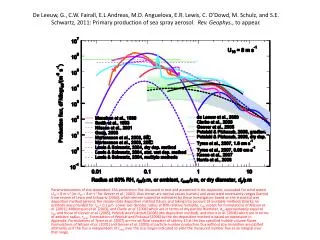
This study by De Leeuw et al. (2011) reviews parameterizations of size-dependent sea spray aerosol (SSA) production fluxes evaluated for specific wind speeds. It discusses the central values and associated uncertainties from existing methods, including those by Lewis and Schwartz (2004) and others. The lower axis indicates radius at 80% relative humidity. Additionally, formulations from various authors such as Nilsson et al. (2001) and Geever et al. (2005) regarding particle production flux are analyzed. The interpretations help in understanding marine aerosol emissions and atmospheric impacts.


Size-Dependent Sea Spray Aerosol Production: Parameterizations and Evaluations
E N D
Presentation Transcript
De Leeuw, G., C.W. Fairall, E.L Andreas, M.D. Anguelova, E.R. Lewis, C. O’Dowd, M. Schulz, and S.E. Schwartz, 2011: Primary production of sea spray aerosol. Rev. Geophys., to appear. Parameterizations of size-dependent SSA production flux discussed in text and presented in the Appendix, evaluated for wind speed U10 = 8 m s‑1 (or U22 = 8 m s‑1 for Geever et al.; 2005). Also shown are central values (curves) and associated uncertainty ranges (bands) from review of Lewis and Schwartz [2004], which denote subjective estimates by those investigators based on the statistical wet deposition method (green), the steady-state deposition method (blue), and taking into account all available methods (black); no estimate was provided for r80 < 0.1 µm. Lower axis denotes radius at 80% relative humidity, r80, except for formulations of Nilsson et al. [2001], Mårtensson et al. [2003], and Clarke at al. [2006] which are in terms of dry particle diameter, dp, approximately equal to r80, and those of Geever et al. [2005], Petelski and Piskozub [2006] (dry deposition method), and Norris et al. [2008] which are in terms of ambient radius, ramb. Formulation of Petelski and Piskozub [2006] by the dry deposition method is based on expression in Appendix. Formulations of Tyree et al. [2007] are for artificial seawater of salinity 33 at the two specified bubble volume fluxes. Formulations of Nilsson et al. [2001] and Geever et al. [2005] of particle number production flux without size resolution are plotted arbitrarily as if the flux is independent of ramb over the size ranges indicated to yield the measured number flux as an integral over that range.