SlideServe
Menu
Préférences
© SlideServe · v2026

Ch 14: Electrode Potentials

hansel avatar
17 diapositives · 467 Views · Aug 31, 2014

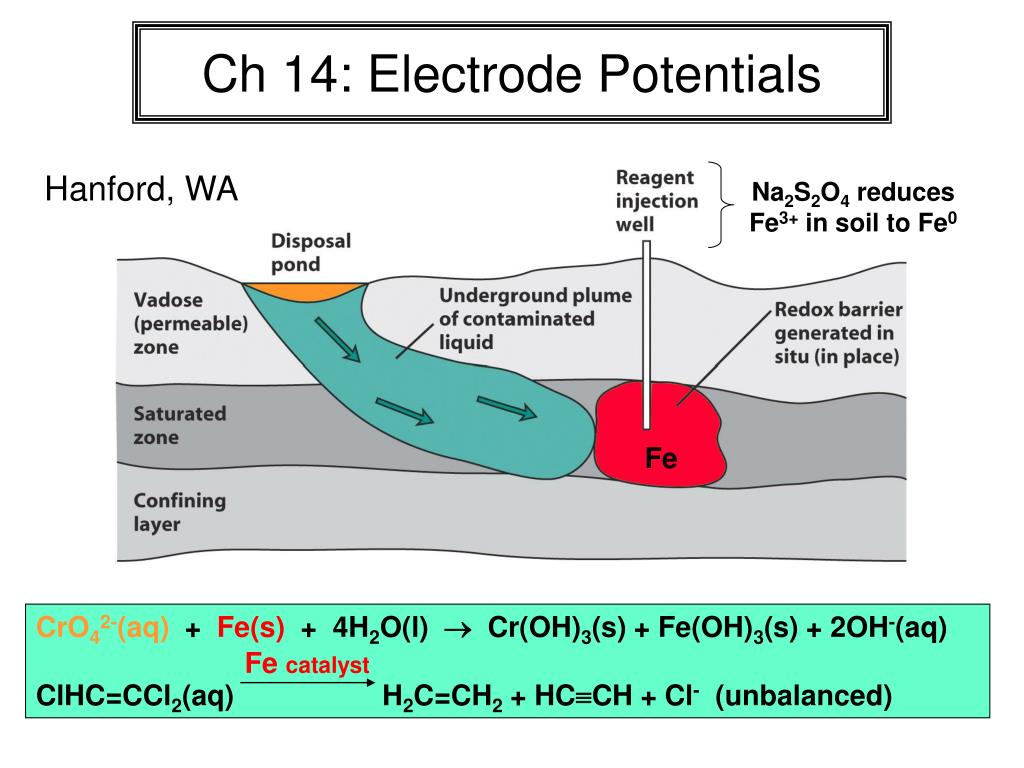
Ch 14: Electrode Potentials. Hanford, WA. Na 2 S 2 O 4 reduces Fe 3+ in soil to Fe 0. Fe. CrO 4 2- (aq) + Fe(s) + 4H 2 O(l)  Cr(OH) 3 (s) + Fe(OH) 3 (s) + 2OH - (aq) ClHC=CCl 2 (aq) H 2 C=CH 2 + HCCH + Cl - (unbalanced). Fe catalyst. Redox Reaction Review
Ch 14: Electrode Potentials - slide 1
01 / 17Ch 14: Electrode Potentials
1 / 17

Télécharger la présentation

Ch 14: Electrode Potentials
Une image / un lien ci-dessous est fourni (tel quel) pour télécharger la présentation

Politique de téléchargement : le contenu du site vous est fourni TEL QUEL pour votre information et votre usage personnel ; il ne peut être vendu, concédé sous licence ni partagé sur d’autres sites sans l’accord de son auteur.Le contenu vous est fourni TEL QUEL, pour votre information et votre usage personnel uniquement. Téléchargez la présentation en cliquant sur ce lien. Lors du téléchargement, si vous ne parvenez pas à télécharger une présentation, l’éditeur a peut-être supprimé le fichier de son serveur.Pendant le téléchargement, si vous ne parvenez pas à obtenir une présentation, le fichier a peut-être été supprimé par l’éditeur.

F I N

Plus de contenu associé

Transcription de la présentation
  1. Ch 14: Electrode Potentials Hanford, WA Na2S2O4 reduces Fe3+ in soil to Fe0 Fe CrO42-(aq) + Fe(s) + 4H2O(l)  Cr(OH)3(s) + Fe(OH)3(s) + 2OH-(aq)ClHC=CCl2(aq) H2C=CH2 + HCCH + Cl- (unbalanced) Fe catalyst

  2. Redox Reaction Review 8H+ + Cr2O72- + 3H2S  2Cr3+ + 7H2O + 3S ox ½ rxn: red ½ rxn: reducing agent = oxidizing agent =

  3. Some Terminology Current in Amp = C/s Volt (emf) = 1 Joule/Coulomb (J/C) Charge on electron (e) = 1.60 x 10⁻¹⁹ C Faraday (F) = charge on a mole of e's = NA x e = 96,485 C/mol

  4. Galvanic Cells (Sec 14-2) • Be able to: • draw the line diagram and cell • identify cathode and anode and 1/2 rxn's • determine electrode polarities & direction of electron flow • give the net cell reaction • Calculate Eocell, E, & K Zn | ZnCl2(1.0M) || CuSO4(1.0M) | Cu(s)

  5. Example p. 315: Write a line diagram for the given cell. Write the half reactions and the net cell reaction.

  6. Standard Potentials (Sec 14-3) Standard Hydrogen Electrode (SHE): aH+ = 1.00 M PH2 = 1.00 atm Eo = 0.00 V (by definition)

  7. a more complete table -

  8. Back to the Zn/Cu galvanic cell: Zn | ZnCl2(1.0M) || CuSO4(1.0M) | Cu(s) E > 0 spontaneous E = 0 equilibrium E < 0 spontaneous reverse direction

  9. The Nernst Equation (Sec 14-4)calculating the non-standard cell potential for aA + bB = cC + dD, from Thermodynamics we know - G

  10. Example p. 321: Find the voltage of the cell in Figure 14-4 if the right half-cell contains 0.50M KCl(aq) and the left half-cell contains 0.010M Cd(NO3)2(aq). Write the net cell reaction and state whether it is spontaneous in the forward or reverse direction.

  11. K Eo and the Equilibrium Constant (Sec 14-5) aA + bB = cC + dD at equilibrium -

  12. Example p. 326: Find the equilibrium constant for the reactionFe3+ + Ag(s) + Cl- = Fe2+ + AgCl(s), which is the net cell reaction in Fig. 14-8.

  13. Electrochemical Measurement of Kw

  14. Reference Electrodes (Sec. 14-6) The Standard Hydrogen Electrode (SHE) is inconvenient to use, so other more practical electrodes are commonly used in the lab and in the field. Their half-potentials have been measured relative to the SHE. Ag/AgCl Reference Electrode AgCl(s) + e = Ag(s) + Cl- Eo = +0.222 V (1.0 M KCl)= +0.197 V (sat’d KCl)

  15. Calomel Reference Electrode ½Hg2Cl2(s) + e = Hg(l) + Cl- Eo = +0.268 V (1.0 M KCl) = +0.241 V (sat’d KCl)

  16. Voltage Conversions Between Different Reference Scales