
Productive Math Talk
E N D
Presentation Transcript
Productive Math Talk Math Alliance April 3, 2012
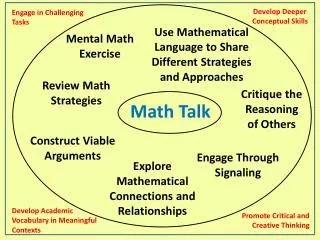
Why promote communication in math classrooms? • Mathematical thinking of students is aided by hearing what their peers are thinking. • Putting thoughts into words pushes students to clarify their thinking. • Teachers can spot student misunderstandings much more easily when they are revealed in discussion instead of remaining unspoken. NCTM-- “a respectful but engaged conversation in which students can clarify their own thinking and learn from others through talk”
What researchers have found… • For many teachers, its not easy to implement in mathematics classrooms. • Few American classrooms display consistent or even occasional use of student talk. • Most classrooms consist of lecturing, asking students to recite, or posing simple questions with known answers. Classroom Discussions: Using math talk to help students learn p. 5
Learning Intention • WALT: • Understand how to use classroom discourse to help students articulate mathematical ideas • We will be successful when: • We can identify the purpose and value of the ground rules, formats, and moves when engaged in a data lesson.
Tools for Classroom Talk • Ground rules for respectful talk and equitable participation • Five productive talk moves • Three productive talk formats
Thinking about the homework reading At your table • Each person shares one point that stimulated your thinking. • Make a connection to your own classroom experience. • Identify commonalities among your group. • Be prepared to share out one idea that you had in common
Why all the talk about classroom talk? • Traditional Classroom Talk • Lecture • Quizzing (Guess what I am thinking) • Sharing time • Group recitation • Student presentations • What is different about what we are considering tonight? • Is this too much for students with disabilities?
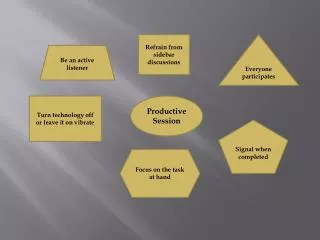
Ground Rules and Equitable Participation: What would be posted in your classroom? • Conditions for Respectful and Courteous Talk • All Students have the opportunity to engage in productive talk about mathematics
Talk Formats Different ways teachers configure classrooms for discussions • Whole group – provide students with practice reasoning opportunities • Small group – provides opportunity for more loosely directed conversation. • Partner – provides an opportunity for students who may have difficulty speaking up.
Moves for Supporting Productive Talk • 1. Revoicing: Teacher repeats some or all of what the student has said. Students verify what was said. • 2. Repeating: Asking students to restate someone else’s reasoning. • 3. Reasoning: Asking students to apply their own reasoning to someone else’s reasoning. • 4. Adding on: Prompting students for further participation. • 5. Waiting: Using wait time.
Experiencing Talk Moves During a Lesson • You will be experiencing a brief data lesson. • Use the card at your table to keep track of the talk moves and formats used throughout the lesson. • You will use the cards to help you during the debriefing conversation.
Lesson Learning Intention and Success Criteria • We are learning to…understand how to extract data from a contextual situation, and represent it as a graph. • We will be successful when…we can interpret a graph from contextual situation and justify our reasoning using information from context.
Ground Rules • Listen to the complete answer without interruptions or comments. • Everyone participates. • Honor everyone’s thinking • When creating work to share, make it large enough for all to read.
Formulate Questions • Collect Data • Represent Data • Interpret Results GAISE: Guidelines for Assessment and Instruction in Statistics Education A Framework for Statistical Problem SolvingGAISE Report (2007)
Critiquing others work Post your table graph in the front of the room. Analyze the charts…. • How are the charts similar? • What questions do you have about the charts? It may sound like • “I don’t understand…” • “Why did you….” • “I like the way you…”
Identifying talk formats and talk moves • Talk Moves • Which ones did you notice? • Why were they used? • How helpful were they/could they be? • How helpful could they have been for students with language barriers? Why?
Troubleshooting • Read your assigned problem/concerns With your table group • Clarify the problem/concern • Share your experiences with this • Clarify the suggestions and add to them • Make a poster with both problem/concerns and suggestions (by the authors and you)
Using Your Best Listening Skills • Prepare for listening • Mentally review the information given to you • Categorize the information • Make notes of informational details • Use a signal as a cue to remember ideas • Seek to differentiate and make connections between inferences facts and opinions • Plan to determine roles based on the lesson, the person you are working with and the students you will teach
Models of Co-teaching • One teach, one observe or assist • Station Teaching • Parallel Teaching • Alternative Teaching • Team Teaching
Reviewing our Collaborative Teaching • Did our co-teaching allow us to use our individual strengths? • How might the students benefit from the co-teaching of this lesson? • What factors would contribute to the success of our teaching? • What challenges did we have to address? • What skills that we have explored in this class might we draw upon when teaching collaboratively?
Getting a head start… • Find 1-2 other people who are teaching at the same (or similar) grade level and using the same text • Find a lesson from your book that addresses one of the four statistical processes • Using the Binder Project, Part C reflection form as a guide, develop a differentiated lesson using the Math Alliance Lesson Plan format. • But before we start…
Reflection on the reading • On a post-it, write down your name and one idea from the reading that you want to try. • On another post-it, write down your name and one idea from class that you want to try. • Bring to the front and stick to the appropriate poster • As you work, use the class poster as a resource for differentiation strategies; if you have questions, ask the person who wrote it.
Strengths of the textbook lessons: Ideas for supplementing lessons: Lesson plan debrief:
In closing… • Read Standards for Mathematical Practice #3, Construct viable arguments and critique the reasoning of others. • Highlight words or phrases that connected to the discussions on Talk Formats/Talk Moves. • In what way will Talk Moves help to develop the Standard for Mathematical Practice?