Comprehensive Review of Electric and Magnetic Fields in Physics 2102
Dive into the essentials of electric and magnetic fields with this thorough review of Physics 2102. Over 15 weeks, you'll explore fundamental concepts such as forces acting on electric charges, electric potential, and the workings of circuits with capacitors, resistors, and inductors. Familiarize yourself with key laws like Maxwell’s equations and understand wave optics, including interference and polarization. This guide will help you identify areas for improvement, prepare for your final exam, and solidify your grasp of important physics principles.

Comprehensive Review of Electric and Magnetic Fields in Physics 2102
E N D
Presentation Transcript
Physics 2102 Gabriela González Physics 2102 Marathon review of the course: 15 weeks in ~60 minutes!
Overview • Fields: electric & magnetic • electric and magnetic forces on electric charges • potential energy, electric potential, work (for electric fields), electric and magnetic energy densities • fundamental laws on how fields are produced:Maxwell’s equations! • Circuits & components: • Capacitors, resistors, inductors, batteries • Circuits: circuits with R and batteries, RC, LR, LC. • Waves : • Speed, frequency, wavelength, polarization, intensity • Wave optics: interference
Electric Field • Forces due to electric fields: F=qE, Coulomb’s Law • Electric field due to: • single point charge, several point charges • Electric dipoles: field produced by a dipole, electric torque on a dipole • charged lines: straight lines, arcs • surface charges: conducting and insulating planes, disks, surfaces of conductors • volume charges: insulating spheres, conductors (E=0 inside). • Electric flux, Gauss’ law, applied to spherical, cylindrical, plane symmetry • Electric potential of a single charge, of several charges, of distributed charges. • Work, potential energy Gauss’ law!
Magnetic Fields • Force exerted by a magnetic field on a charge, on a current. • Magnetic field lines: always closed! • Magnetic fields created by currents:wires, loops, solenoids (Biot-Savart’s law, Ampere’s law) • Magnetic dipoles: field produced by a dipole, torque on a dipole
Induced fields • Changing magnetic flux creates an induced electric field (and a current if there is a wire!): Faraday’s law • Changing electric flux creates an induced magnetic field: Ampere-Maxwell’s law, displacement current
Maxwell’s equations Plus:
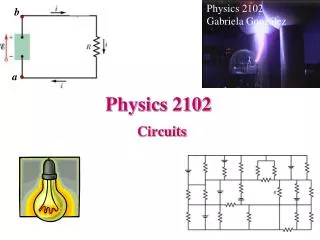
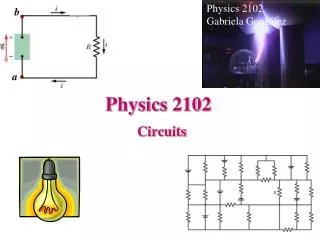
V=iR, Q=CV, E=-Ldi/dt Resistivity: E=Jr, R=rL/A Parallel plate, spherical, cylindrical capacitors Capacitors with dielectrics Resistors, capacitors in series and in parallel Power delivered by a battery: P=iE Energy dissipated by a resistor: P=i2 R=V2/R Energy stored in capacitors, inductors (energy stored in electric, magnetic fields) Ideal and real batteries (internal resistance) Resistors, Capacitors, Inductors V=iR Q = CV
DC Circuits • Single and multiloop circuits: • Junction rule for current • Loop rule for potential difference • RC/RL circuits: • time constant: t=RC, L/R • charging/discharging • POTENTIAL across capacitor CANNOT CHANGE SUDDENLY! • CURRENT in inductor CANNOT CHANGE SUDDENLY !
DC circuits Plus: resistors and capacitors in series and in parallel
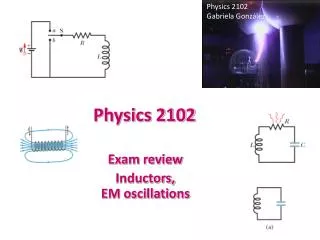
AC Circuits • LC Oscillations: • careful about difference between frequency & angular frequency! • Physical understanding of stages in LC cycle • RLC circuits: energy is dissipated in the resistor.
Electromagnetic waves Wave propagating in x direction: E=Em sin(kx-wt) j B=Bm sin(kx-wt) k c=Em/Bm=(m0e0)-1/2: speed of light in vacuum S=ExB/m0=(Em2/m0c)sin2(kx-wt) i : Poynting vector I= Em2/2m0c: intensity, or power per unit area Spherical waves: I=Ps/4pr2 Radiation pressure: F/A=I/c (absorption), F/A=2I/c (reflection) Polarizers: I=I0/2 (unpolarized light), I=I0cos2q (polarized light)
Wave Optics • Refraction: l= l0/n, v=c/n, n2sinq2=n1sinq1 v1sinq2=v2sinq1 • Two-beam Interference due to difference in phase : DF/(2p)=DL/l • DL=ml (constructive), DL=(m+1/2)l (destructive) • Coherent light through a double slit produces fringes: dsinq=ml (bright), dsinq=(m+1/2)l (dark), fringe spacing Dx=Ll/d
Overview • Fields: electric & magnetic • electric and magnetic forces on electric charges • potential energy, electric potential, work (for electric fields), electric and magnetic energy densities • fundamental laws on how fields are produced:Maxwell’s equations! • Circuits & components: • Capacitors, resistors, inductors, batteries • Circuits: circuits with R and batteries, RC, LR, LC. • Waves : • Speed, frequency, wavelength, polarization, intensity • Wave optics: interference
Summary • Think about and understand basic concepts! • Look at your past exams and quizzes: why didn’t you get 100%? Predict your problems in the final exam! • Study the equation sheet, invent a problem for each formula. • Read all lecture slides, review hwk problems and problems in class. • Practice with a couple of past exams: timing is important! • Save time to eat lunch and relax the hour before the exam. • Enjoy the summer!