The Forgotten War: Understanding the Korean Conflict and Its Ongoing Impact**
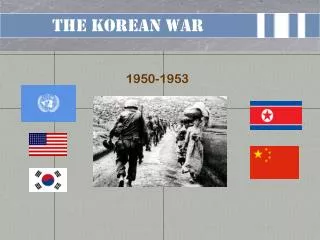
The Korean War, often referred to as "The Forgotten War," resulted from the division of Korea after World War II, with the U.S. backing the South and the USSR supporting the North. The conflict erupted on June 25, 1950, when North Korea invaded the South. Despite significant military engagement, the war ended in a stalemate, leaving Korea divided along the 38th parallel. Today, South Korea thrives as a democratic and growing economy, while North Korea remains isolated and oppressive. This historical overview explores the causes, events, and lasting legacies of this pivotal conflict.

The Forgotten War: Understanding the Korean Conflict and Its Ongoing Impact**
E N D
Presentation Transcript
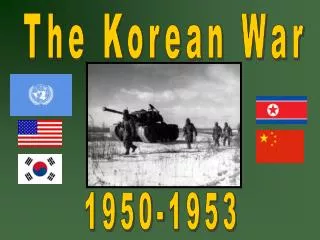
The Korean War The Forgotten War
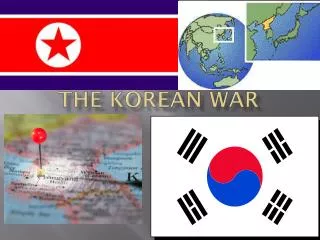
Where is Korea? • Peninsula just north of China, connecting to Russia, and west of Japan. • Under Japanese control from 1910-1945
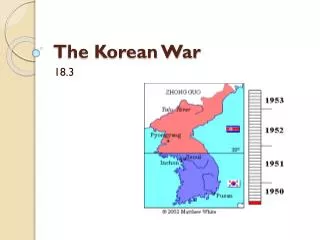
Why is it split? • After WWII, U.S. and USSR agreed to hold Korea until it could reform a government. • US holds south, USSR holds north • Split along 38th parallel • USSR refused to cooperate with free elections; set up Communist gov’t in north
How did war break out? • Both sides want unification • Border skirmishes from 1948-50 • North Korea invaded the South on 6/25/50 • Almost complete takeover • Seoul taken within three days
Why did the U.S. get involved? • Korea wasn’t important, but Japan was • Background: • China fell in ‘49 • USSR got the bomb in ‘49 • Greece and Turkey threatened • Alger Hiss and Rosenbergs arrested for treason
What happened? • US troops were committed; retook South Korea after key battle at Inchon • 9/29/50- Pushed NK back over 38th parallel • Plan changes from containment to overthrow of Communist gov’t • 10/20/50 – UN troops capture PyongYang (capitol of NK)
“Unforgettable: The Korean War” • http://www.youtube.com/watch?v=ZOknJm1mEjI
What was the result? • Borders didn’t change • US begins massive buildup of military power at home • China has new pride after defeats by Japan
What are the Koreas like today? • South Korea • Fast growing economy through ‘90s. • Modern, democratic, industrialized.
North Korea • All news controlled by gov’t • 100-200,000 prisoners in concentration camps • No freedom of speech, religion • Cannot move within country or abroad • Only elites own vehicles • Decisions on who to trade with in ‘90s resulted in famine- up to 400,000 died
Public executions without trial for many offenses • Guilt by association: family can be imprisoned as well • Altogether – 1/5-2 million unnatural deaths in 40 years
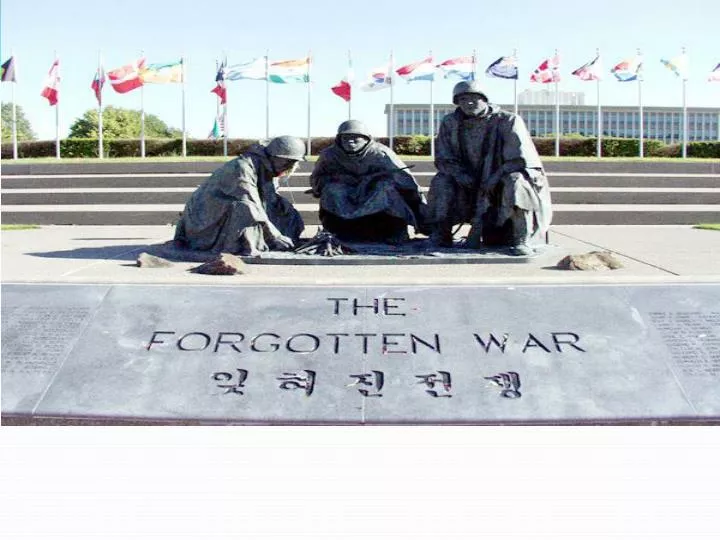
Why is “The Forgotten War?” • Not classified as a war- called a “police action” • Goals weren’t clear • WWII – stop Nazis from taking over the world; Japanese attacked us • Korea- contain Communism in place nobody has heard of • No resolution – still divided